The ten US clinics and hospitals whose published TPLO prices we read on 12 November 2026 give figures from $2,600 to $6,700 for one knee, depending on the dog’s weight and what the fee bundles. One of them adds $2,000 to $2,500 if a board-certified surgeon operates. A survey paid for by a lender puts the average at $3,525 a knee, and one insurer says “roughly $6,000 to $10,000”. None of these is a national price, and we don’t average them. This page, part of our surgery, tests and emergencies hub, sets every figure side by side with who published it and when, then takes the bill apart line by line, shows what would be left to pay after insurance, and ends with the questions to ask before you agree to an estimate.
General information about costs, insurance and the rules, not veterinary, legal, insurance, tax or financial advice. Your vet decides what care is right for your pet; your policy’s wording and your insurer decide what a claim pays; your card or loan agreement decides what credit costs.
This page is about money only. Whether a dog needs knee surgery, and which operation, is a clinical question: your vet decides what is right for your pet. For the other knee operations and their bills, see dog ACL (CCL) surgery cost.
Published TPLO prices, side by side
Every figure below was read on the publisher’s own page on 12 November 2026. A “posted fee” is what one clinic or hospital says it charges, and a hospital’s published estimate is a general range; neither is a quote for your dog. The rows run from the lowest figure to the highest. Two rows come from publishers with something to sell: a lender that finances vet bills and an insurer that sells cover against them.
| Who published it | Figure, one knee | What it covers, in the publisher’s words | Page date | Why it might lean |
|---|---|---|---|---|
| Bernardo Heights Veterinary Hospital, San Diego, California. A private clinic’s posted fee | $2,600 for dogs of about 40 to 89 lb | “All inclusive” surgery price; the 8-week exam and x-rays are included; the orthopedic exam is free; pre-operative tests are “discounted”, so billed apart. Other weights: “contact us” | Undated (© 2026) | One clinic’s advertised price, for one weight band |
| Animal Humane Society pet clinics, Twin Cities, Minnesota. A nonprofit’s posted fee | $3,309 to $3,609 standard; $3,088 to $3,388 reduced, for owners who qualify by income | One line: “TPLO/TTA with an external specialty surgeon”. What the fee includes is not stated; a presurgical exam comes first | Undated | A subsidized nonprofit; one price line for two different operations |
| Surgery Vet, Fort Walton Beach, Florida. A private surgical practice’s posted fee | $3,400 up to 90 lb; $3,900 over 90 lb | “All inclusive fee”: intake exam, bloodwork, x-rays before and after, anesthesia and monitoring, plate and screws, hospital stay “as required”, take-home medicines, rechecks. Not the 8-week x-rays: $200 more | Undated | One practice’s posted fee |
| CareCredit, a medical credit card issued by Synchrony Bank. A lender’s survey | $3,525 average, “CCL TPLO surgery (per knee)”, dogs | The procedure; the page says fees such as an “in-office visit” may be charged on top. The sample and what the average includes are not published | 2025-2026 study by ASQ360° for Synchrony | The publisher finances vet bills; method not shown |
| CVETS, Columbia, South Carolina. A private 24-hour specialty hospital’s posted fee | $4,000 fixed | Covers “everything from the initial examination to surgery and follow-up visits”; the page says the dog “will likely stay one night”. A footnote says there may be an added cost for dogs that need “additional anesthesia screening or nonstandard implants” | Undated (© 2026) | One hospital’s posted fee |
| True Companions clinic, Denver, Colorado. A nonprofit shelter clinic’s posted fee | $4,000 to $4,200 “for animals up to 80lbs” | Not stated | Undated (© 2026) | A nonprofit; one line with no detail |
| Zoomies Veterinary Surgery & Dental, Tipp City, Ohio. A private clinic’s posted fee, itemized | Surgery package $4,297 up to 90 lb, $4,789 over 90 lb. With the consultation stage: $4,386 to $5,283, or $4,878 to $5,775 | Package: anesthesia and monitoring, IV fluids, pain control, the operation, plate and screws, x-rays after surgery, the 2-week and 8-week rechecks with x-rays. Exam, diagnostic x-rays, bloodwork and medicines before surgery are priced apart (below) | “Prices effective October 2026” | One clinic’s posted fee |
| University of Missouri Veterinary Health Center, Columbia, Missouri. A teaching hospital’s owner handout | $4,500 to $5,000 “for small to large dogs”; $5,500 to $6,000 for giant breeds | Includes “everything at your first visit”, but not the recheck at eight weeks, which is “charged separately” | Handout (PDF) dated August 2023, still the one linked from the hospital’s TPLO page | What one hospital estimated three years ago; a referral hospital |
| Abel Veterinary Hospital, Milpitas, California. A private clinic’s posted fee | $4,800 to $5,300; a board-certified surgeon adds an estimated $2,000 to $2,500 | Not stated for this line. The same page prices bloodwork and a cone as optional extras | Undated | One clinic, a new hospital by its own account |
| Anicira Veterinary Center, a nonprofit: San Diego area, California and Manassas, Virginia. Posted fees | California: $5,200; both knees $7,500; $300 more over 100 lb. Virginia: $4,850 to $5,750 | Pre-anesthetic exam, anesthesia and monitoring, pain medicine, and a cone, other medicines and a follow-up exam “if necessary”. Bloodwork is described apart, not in the list. Outpatient | Undated | A nonprofit; pets must be spayed or neutered to qualify |
| University of Minnesota Veterinary Medical Center, St. Paul, Minnesota. A teaching hospital’s published estimate sheet | $5,500 to $6,700 | The sheet says surgeries “do not include pre-op rads or any workup” and that most include 36 hours in the wards. The exam and workup are priced apart (below). It calls the figures general, not an estimate for one pet | Undated; the sheet is linked from the hospital’s small animal surgery page | What one referral hospital published; a general range |
| Lemonade. An insurer’s figure | “roughly $6,000 to $10,000 per leg” | Not itemized; no source or sample given | “Last Updated: Oct 13, 2026” | The publisher sells cover against high vet bills |
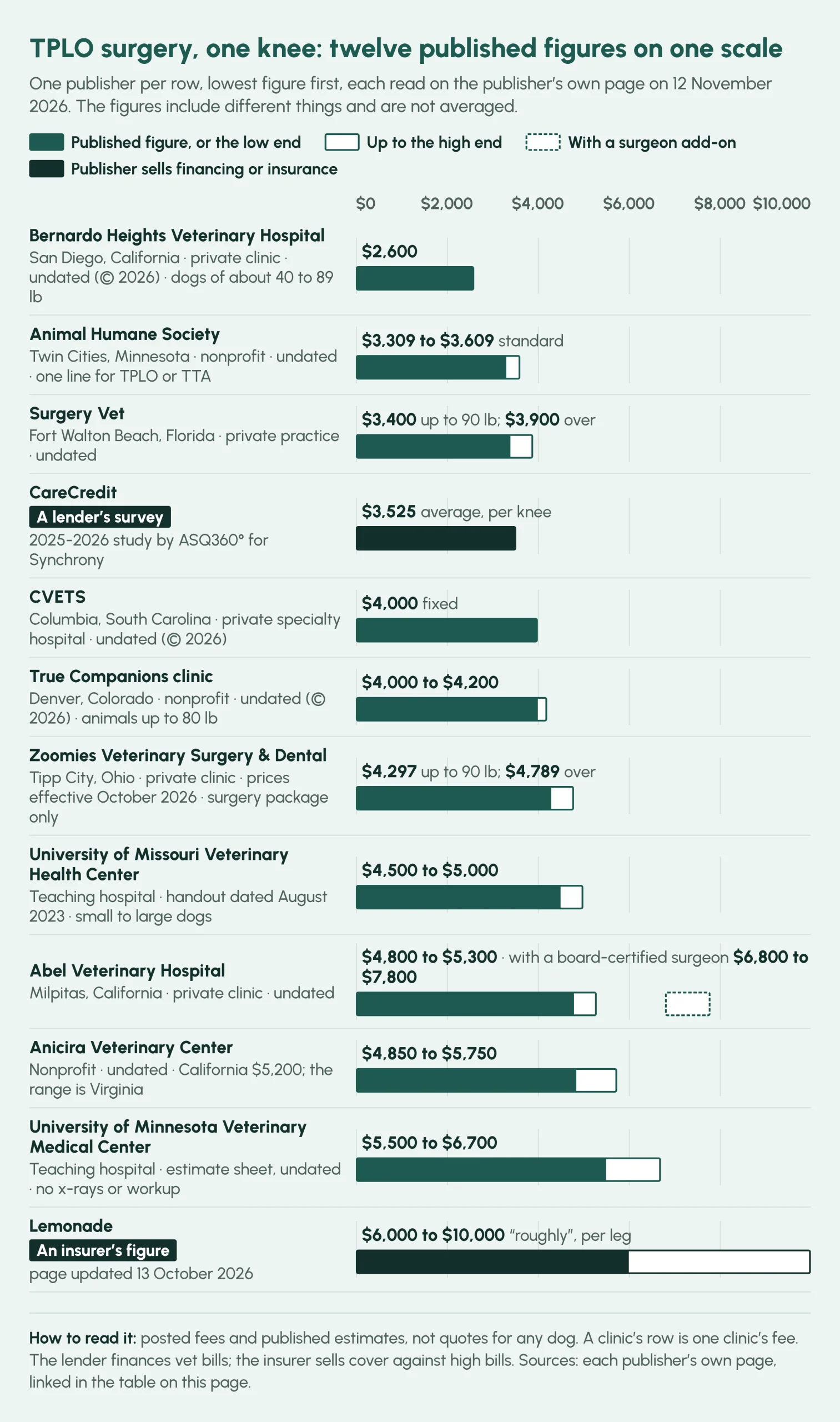
Two things stand out. Eight of the ten clinics’ and hospitals’ figures for one knee stay at or below $6,000, the bottom of the insurer’s range. Two reach into it: Minnesota’s teaching-hospital estimate ($5,500 to $6,700) and Abel’s fee with a board-certified surgeon added ($4,800 + $2,000 = $6,800 to $5,300 + $2,500 = $7,800). And the lender’s survey average sits among the lower posted fees. The sources conflict, and we can’t tell you which is closer to the bill in your town.
One caution about the table itself. Clinics that publish a price may be the ones that compete on it, and three here are nonprofits. In our searches, large referral hospitals seldom published a TPLO fee: we found two teaching hospitals’ estimates and no posted fee from a private big-city specialty or emergency hospital. So if your estimate is above every figure here, this table can’t tell you why: there is no published figure of that kind to hold it against. The vet estimate builder adds these same published figures up line by line.
What the surgery is
TPLO stands for tibial plateau leveling osteotomy. The American College of Veterinary Surgeons’ owner page on cranial cruciate ligament disease (read 12 November 2026) describes the cranial cruciate ligament as one of the main stabilizers of a dog’s knee, the counterpart of the human ACL, and TPLO as an operation in which the surgeon makes a curved cut at the top of the shin bone, rotates that piece to a planned position and fixes it with a bone plate and screws. That is why the bill has an implant on it, and x-rays before and after.
What the bill is made of, line by line
An estimate is the clinic’s forecast before treatment; the invoice is the bill afterwards. On the lists that itemize (Zoomies, Missouri and Minnesota), the cost comes in two parts: the visit that confirms the diagnosis, and the surgery itself. The lines below are the ones the posted price lists name. “If needed” lines are ones a clinic adds only for some dogs. Each figure is a posted fee read on 12 November 2026 unless the row says otherwise.
| Line on the estimate | Published figures | Included, or billed apart? |
|---|---|---|
| Orthopedic exam and consultation | $0 at Bernardo Heights (“complimentary”); $89 at Zoomies; $216 at the University of Missouri’s surgery service, applied to the estimate if surgery follows; $312 at the University of Minnesota’s teaching hospital | Often billed apart, at the first visit. Inside the fixed fee at CVETS and Surgery Vet |
| Diagnostic x-rays and sedation, if needed | Zoomies: x-rays $298 plus sedation $85, so $383. General x-ray prices on other lists: Lehigh Valley Humane Society (Pennsylvania) $128 for multiple views; Animal Humane Society $153.96 to $305.61 by number of views; CareCredit’s survey average $172 for two to three views (a lender’s figure). Minnesota prices the exam with a workup of sedated x-rays and bloodwork at $1,200 to $1,400 | Billed apart at Zoomies, which says films from your own vet may do, and at Minnesota. Included at Surgery Vet |
| Pre-anesthetic bloodwork, if needed | $50 at the Humane Society of South Carolina; $86 at Lehigh Valley Humane Society; $105 at Helping Hands, a surgery-and-dentistry clinic in Richmond, Virginia; $115 to $248 at Zoomies; $218 for a basic panel or $395 for a comprehensive one at Abel | Often billed apart. Included at Surgery Vet. A recent result from your own vet may not need repeating (Zoomies) |
| Medicines before surgery, if needed | $170 to $266 at Zoomies, by the dog’s size | Billed apart at Zoomies, which says your own vet may supply them |
| Deposit | $500 at Zoomies to hold the surgery date, taken off the surgery price | Not an extra cost if it is credited. Ask whether it is refundable |
| The surgery: anesthesia and monitoring, IV fluids, pain control, the operation, the plate and screws, x-rays straight after | The fees in the first table. At Zoomies, the one list that separates it: $4,297 up to 90 lb, $4,789 over | One package price at every clinic we read. None prices the implant or the anesthesia on its own line |
| Hospital stay | No posted per-night fee found | Inside the fee where it is mentioned: CVETS (likely one night), Surgery Vet (“as required”), Minnesota (36 hours in the wards for most surgeries). Missouri’s page says most dogs go home the day after surgery. Anicira is outpatient |
| Take-home medicines and a cone | A cone alone: $8 at the Humane Society of Tampa Bay, $15 at Abel, $19 at Helping Hands. No posted figure for the medicines after a TPLO | Medicines included at Surgery Vet; “if necessary” at Anicira. Zoomies sends the dog home in a cone |
| Recheck visits | No separate posted figure | Included at CVETS, Surgery Vet, Zoomies (2 and 8 weeks) and Bernardo Heights (8 weeks) |
| X-rays at about eight weeks | $200 at Surgery Vet, or no charge to review films taken by your own vet. “Charged separately” at Missouri, amount not given | Included at Bernardo Heights and Zoomies. Often billed apart elsewhere |
| Rehabilitation, if recommended and chosen | No posted figure found | Optional and not included at Zoomies. Ask |
| Complications, or surgery on the other knee | Both knees at once at Anicira’s California hospital: $7,500, against $5,200 for one | Not included in any posted fee. Zoomies says a second knee later “costs the same” and needs no new consultation |
One itemized list, added up
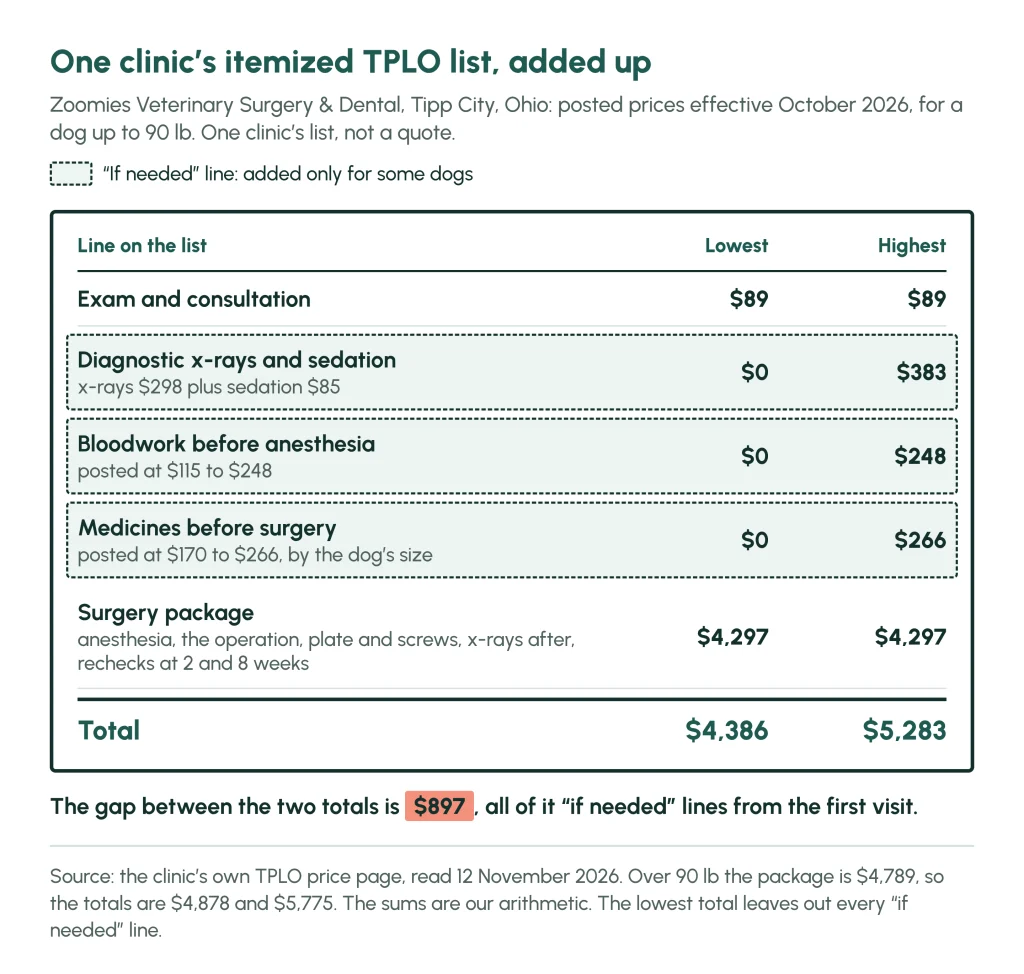
Zoomies is the only clinic we found that prints the whole sum, so it shows how a “from” price grows. For a dog up to 90 lb:
- Lowest: exam $89 + surgery package $4,297 = $4,386.
- Highest: exam $89 + x-rays and sedation $383 + bloodwork $248 + medicines $266 = $986 before surgery; $986 + $4,297 = $5,283.
- Over 90 lb, the package is $4,789, so the same sums give $4,878 and $5,775.
The gap between the two ends is $897, and all of it is “if needed” lines from the first visit. That is the part of an estimate worth reading most closely: which of those lines are on yours, and which your own vet has already done.
How much of the fee is wages?
A small part, on national pay figures and our assumed hours. The Bureau of Labor Statistics puts the mean wage for veterinarians at $68.60 an hour and for veterinary technologists and technicians at $23.61 (Occupational Employment and Wage Statistics, May 2025, national, read 12 November 2026). Missouri’s teaching hospital says on its TPLO page that the operation takes about an hour and a half, with the anesthetic running longer. If we assume 3 hours of a veterinarian’s time and 6 hours of technician time across the consultation, surgery and recovery, wages come to 3 × $68.60 + 6 × $23.61 = $205.80 + $141.66 = $347.46.
The hours are our assumption, not a published figure, and the BLS average covers all veterinarians, not board-certified surgeons, whose pay it doesn’t report separately. Wages also leave out benefits and payroll costs. On those assumptions, hourly pay is a small part of any fee in the first table. The rest has to cover the plate and screws, the saw and other equipment, anesthesia drugs and monitoring, x-rays, the building and the other staff. No clinic we read publishes those costs, so we give no figures for them.
Why the figures differ

- The dog’s weight. Heavier dogs cost more on every list that says: $500 more over 90 lb at Surgery Vet, $492 more over 90 lb at Zoomies, $300 more over 100 lb at Anicira, and $1,000 more for giant breeds at Missouri, which gives the reason as “a larger bone plate and additional screws”. Bernardo Heights’ $2,600 is for dogs of about 40 to 89 lb only, and True Companions’ figure stops at 80 lb.
- Who operates. Abel prices a board-certified surgeon at an estimated $2,000 to $2,500 on top of its own fee. Animal Humane Society’s line is for an outside specialty surgeon. At a teaching hospital the surgeon may be a resident working under a faculty surgeon (Missouri’s page says so).
- What is bundled. A fixed fee that starts at the first exam (CVETS) and a surgery-only price (Zoomies’ $4,297, or Minnesota’s range, which leaves out x-rays and any workup) are different things. Compare what each covers, not the headline.
- Who runs the clinic. Three of the ten are nonprofits, and one of them has a lower price list for owners under an income limit. Nonprofits set conditions: Anicira takes only spayed or neutered pets, and Animal Humane Society’s specialty services are “only available to otherwise healthy animals”.
- Where it is. The posted fees come from eight states. We found no source that publishes TPLO prices by region, so we can’t put a number on the difference.
- When it was published. Missouri’s January 2021 handout gave $4,000 to $4,500 for the same operation; its August 2023 handout gives $4,500 to $5,000. Nationally, the BLS consumer price index for veterinarian services (series CUUR0000SS62054) rose 4.6% in the year to September 2026, from 399.189 to 417.438, against 3.7% for all items (324.800 to 336.940). BLS collected no October 2025 figures, so September is the latest month with a year-earlier figure to set it against. Why vet costs have risen has the longer record.
Your share with pet insurance
Three parts of a policy decide what it pays toward a TPLO: whether the knee problem is covered at all, the waiting period, and the arithmetic. Your policy’s wording and your insurer decide; the examples below show how the terms work, each taken from a public document.
Orthopedic waiting periods
A waiting period is the time after a policy starts during which a new problem isn’t covered. Some policies set a longer one for knees. Physicians Mutual’s sample pet policy (form P970 (0821)) sets a six-month orthopedic waiting period for dogs, which it says can be waived if a vet completes its orthopedic waiver form in time. The sample policy booklet Pets Best publishes for Maine shows both versions in one document: its base form (APIC-PBI0001-ILL, 12/2015) has a six-month wait for cruciate ligament events, and the Maine endorsement attached to it (APIC-PBI0004-AE-ILL-ME, 11/2022) replaces that with 30 days.
The reason is state law. Maine’s statute caps the wait at 30 days “for illnesses or orthopedic conditions not resulting from an accident” (24-A M.R.S. 3156(2), read 12 November 2026), and so does Ohio’s. Ohio’s pet insurance statute, in force since 22 January 2025, lists “ruptured cranial cruciate ligaments” among orthopedic conditions (R.C. 3970.01(D)) and says of waiting periods (R.C. 3970.05(C), read 12 November 2026):
(1) The waiting period shall not exceed thirty days for illnesses or orthopedic conditions not resulting from an accident. (2) The waiting period shall not apply to an accident.
The same section requires the policy to let the wait be waived after a veterinary exam, which the policyholder pays for unless the policy says otherwise, and bars a waiting period on renewal. Thirteen more states have a 30-day cap in their pet insurance statutes: California, Delaware, Florida, Hawaii, Louisiana, Maryland, Montana, Nebraska, New Hampshire, Pennsylvania, Rhode Island, Vermont and Washington, as read for our state-by-state table of pet insurance laws on 11 and 12 November 2026 (New Hampshire’s in a copy of the official text archived on 17 December 2025). New Jersey’s takes effect on 1 January 2027. For the other states we know of no pet insurance statute that caps the wait: the NAIC’s Summer 2026 chart of state activity lists none, and we did not search each state’s code ourselves. There, the policy decides. The waiting-period checker works through the dates for the terms you enter.
Pre-existing and “bilateral” clauses
A pre-existing condition is one that showed before the policy started or during a waiting period, and each sample policy we read excludes it. With knees there is a second clause to look for, because ACVS’s owner page says 40 to 60% of dogs that have the condition in one knee will at some point develop a similar problem in the other. A bilateral condition is one that can affect both sides of the body. Three public documents show how differently the clause can be worded:
- Healthy Paws’ sample policy (form LD-50812, 07/18) excludes future treatment of a leg when “cruciate ligament problems to any other leg” existed before the policy’s effective date.
- Pets Best’s Maine booklet lists cruciate ligament events as a bilateral condition and excludes one if the pet ever had a pre-existing condition “consistent with that same Bilateral Condition on either side of the body”.
- Physicians Mutual’s form treats a cured pre-existing condition as new after twelve months free of symptoms and treatment, then adds: “This does not apply to ligament and orthopedic conditions.”
These are three documents, not a survey of the market. In Ohio the insurer “has the burden of proving that the preexisting condition exclusion applies” (R.C. 3970.05(A)). More on the definitions in pre-existing conditions in pet insurance.
The arithmetic, in both orders
The deductible is the amount you pay before the policy pays anything; the reimbursement percentage is the share of the covered bill the insurer pays. Policies apply them in one of two orders, and the order changes the answer. Take an example: a covered $4,000 bill (the fixed fee CVETS posts, before any extra its footnote allows), a $500 annual deductible with nothing used yet, 80% reimbursement, and an annual limit that isn’t reached.
| Order | Sum | Policy pays | You pay |
|---|---|---|---|
| Deductible first, then the percentage | ($4,000 − $500) × 80% | $2,800 | $1,200 |
| Percentage first, then the deductible | ($4,000 × 80%) − $500 | $2,700 | $1,300 |
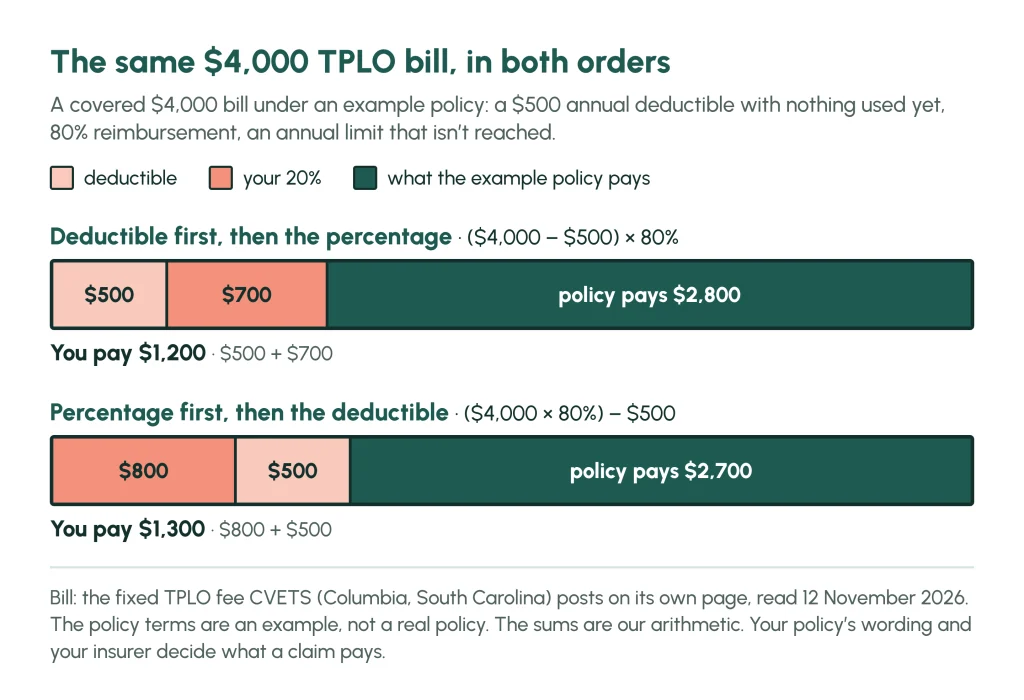
MetLife’s Ohio sample policy (form PET21-01-V) prints a deductible-first example. The Pets Best booklet and the Healthy Paws form apply the percentage first. Lines the policy doesn’t cover come off before either sum: the Healthy Paws form excludes “veterinary examination fees”, and the Pets Best booklet covers exam fees and rehabilitation only where the declarations page shows them as supplemental benefits. If the policy has an annual limit, the payout stops there. The Pets Best booklet pays the policyholder unless you ask in writing for payment to go to the vet, so ask the clinic whether it wants the full bill paid at discharge. Put your own estimate and policy terms into the pet insurance payout calculator, which works both orders.
Paying the bill
Some clinics and hospitals ask for part up front. Zoomies takes $500 to hold a surgery date. Missouri’s surgery service takes a deposit to book the appointment, returned if you cancel more than 24 hours ahead and applied to the bill otherwise. For emergency admissions, Ohio State’s Veterinary Medical Center says in its 2026 emergency-service sheet that once a care plan is agreed it asks for a deposit of “75 percent of the high end of the estimate”. These are three hospitals’ own terms, read on 12 November 2026; yours will have its own.
If the balance is more than you can pay at once, ask the clinic what it offers before looking elsewhere: vet payment plans explains what clinics do and don’t agree to. Several of the clinics above say on their price pages that they take third-party financing. CareCredit, a medical credit card issued by Synchrony Bank, describes its own promotions (read 12 November 2026) as “no interest if paid in full within” 6, 12, 18 or 24 months on purchases of $200 or more, with a 32.99% purchase APR for accounts opened since 30 May 2024.
“No interest if paid in full” is deferred interest, not 0%. Federal advertising rules require such an offer to say that interest will be charged from the date of purchase if the balance isn’t paid in full within the period (12 CFR 1026.16(h), eCFR up to date as of 9 November 2026). On a $4,000 balance and a 12-month promotion, clearing it in time takes $4,000 ÷ 12 = $333.34 a month (rounded up), which may be more than the minimum payment on the statement. The deferred-interest calculator shows what is left, and what interest is added, for the payment you plan. If no option fits, help with vet bills lists where assistance comes from and its limits.
What to ask before you agree
Ask the clinic for a written, itemized estimate, then go down it with these:
- Is this one knee, and does the price change with my dog’s weight?
- Does it include the exam, the diagnostic x-rays and the bloodwork, or were those billed at the first visit? Will you accept recent x-rays and bloodwork from my own vet?
- Are anesthesia, the plate and screws, x-rays after surgery and the hospital stay all inside the surgery price? How many nights?
- Are take-home medicines, the cone, recheck visits and the eight-week x-rays included? If not, what does each cost?
- Is rehabilitation on the estimate, and is it optional?
- Who performs the surgery, and does the price change with the surgeon?
- What happens to the bill if there is a complication?
- How much is the deposit, is it credited, and when is the balance due?
If you have insurance, check four things in the policy before the surgery date: the waiting period for orthopedic or cruciate conditions and whether it has passed, any bilateral or pre-existing clause, the deductible left and the reimbursement percentage with the order they apply in, and the annual limit. If an insurer’s answer doesn’t match your policy’s wording, your state insurance department takes complaints; the NAIC keeps a directory of the departments. If you plan to use credit, read the promotion’s end date and the APR after it before you sign.
What we could not confirm
- What Animal Humane Society’s, True Companions’ and Abel’s TPLO lines include: their pages don’t say.
- A posted fee from a large-city specialty or emergency hospital, a per-night hospital fee, and a rehabilitation fee: we found none on a clinic’s or hospital’s own page.
- Whether the University of Missouri’s 2023 estimate still holds: the handout is the one its TPLO page links today, but it carries no later date.
- When the University of Minnesota’s estimate sheet was last changed: it is undated.
- Pet insurance law in the states outside the sixteen named above: we relied on the NAIC’s Summer 2026 chart and did not search each state’s code.
- How CareCredit’s survey average was built: the sample size and what the figure includes are not published.
Sources checked on 12 November 2026. Posted fees change without notice; several of the price pages are undated. We will recheck them, and the consumer price index line, when the November figures come out in mid-December 2026.
Sources
- Bernardo Heights Veterinary Hospital: TPLO surgery price (posted fee, read 12 November 2026)
- Animal Humane Society: dental and specialty services pricing (posted fees, read 12 November 2026)
- Surgery Vet: TPLO all-inclusive fee (posted fee, read 12 November 2026)
- CareCredit: veterinary procedure costs, 2025-2026 Synchrony study by ASQ360 (a lender's survey)
- CVETS: TPLO fixed pricing (posted fee, read 12 November 2026)
- True Companions clinic: TPLO price (posted fee, read 12 November 2026)
- Zoomies Veterinary Surgery & Dental: TPLO pricing, effective October 2026
- University of Missouri Veterinary Health Center: TPLO owner handout (August 2023)
- University of Missouri Veterinary Health Center: cranial cruciate ligament disease and the TPLO (owner page)
- University of Missouri Veterinary Health Center: TPLO owner handout (January 2021, superseded)
- University of Missouri Small Animal Surgical Service: FAQs (consultation fee, deposit)
- University of Minnesota Veterinary Medical Center: small animal surgery, with its linked sheet of estimates for common surgical costs (undated, read 12 November 2026)
- Abel Veterinary Hospital: surgery prices (posted fees, read 12 November 2026)
- Anicira Veterinary Center: orthopedic surgery pricing, San Diego
- Anicira Veterinary Center: orthopedic surgery pricing, Manassas
- Lemonade: TPLO surgery cost (an insurer's figure, updated 13 October 2026)
- American College of Veterinary Surgeons: cranial cruciate ligament disease (owner page)
- Lehigh Valley Humane Society: clinic services and fees
- Humane Society of South Carolina: fee list
- Helping Hands Veterinary Surgery & Dentistry of Virginia: surgery pricing
- Humane Society of Tampa Bay: spay and neuter cost (published 15 September 2026)
- BLS Occupational Employment and Wage Statistics, May 2025 (veterinarians 29-1131; veterinary technologists and technicians 29-2056)
- BLS CPI-U, veterinarian services, series CUUR0000SS62054 (September 2025 and September 2026)
- BLS CPI-U, all items, series CUUR0000SA0 (September 2025 and September 2026)
- Ohio Revised Code 3970.05, pet insurance policy conditions (effective 22 January 2025)
- Ohio Revised Code 3970.01, pet insurance definitions
- Maine Revised Statutes Title 24-A, section 3156, pet insurance policy conditions
- Physicians Mutual: sample pet insurance policy, form P970 (0821)
- Pets Best: sample accident and illness policy booklet for Maine (APIC-PBI0001-ILL with Maine endorsement, PDF modified 10 September 2026)
- Healthy Paws: sample pet health insurance policy, form LD-50812 (07/18)
- MetLife Pet: sample policy, form PET21-01-V (Ohio)
- Ohio State University Veterinary Medical Center: emergency service, what to expect (2026)
- CareCredit: understanding promotional financing (the lender's own terms, read 12 November 2026)
- 12 CFR 1026.16(h), Regulation Z, deferred-interest advertising (eCFR up to date as of 9 November 2026, read 12 November 2026)
- NAIC: state insurance departments directory