There is no single price for vet care, but there are published ones. On the fee lists we read on 12 November 2026, a routine exam was $55 to $75 at three nonprofit clinics, an emergency exam was $175 to $292 at three university teaching hospitals, a dog spay ran from $150 for a small dog to “$500+” for a very large one on nonprofit clinics’ lists, with $455 as the average in a lender’s national survey, and TPLO knee surgery ran from $3,400 at one private practice to “$6,000 to $10,000” in one insurer’s estimate. Prices are also rising faster than most things: the Bureau of Labor Statistics’ price index for veterinarian services rose 4.6% in the year to September 2026 and 69.4% in ten years, against 3.7% and 39.6% for prices overall. This page is the overview for our routine vet costs guides.
General information about costs, insurance and the rules, not veterinary, legal, insurance, tax or financial advice. Your vet decides what care is right for your pet; your policy’s wording and your insurer decide what a claim pays; your card or loan agreement decides what credit costs.
Below: the published prices side by side, the government’s own figures on how fast vet prices have moved, what the public record does and doesn’t show about why, and a real posted estimate read line by line. Every figure names who published it and when. We don’t average them, and we don’t say what any vet should charge.
Published prices, side by side
No government agency collects what vets charge for a given procedure. What exists is a patchwork: clinics and teaching hospitals that post their fees, a survey commissioned by a company that lends money for vet bills, and estimates from companies that sell pet insurance. Each has a reason to sit high or low, so we show them together and say who is speaking.
- A nonprofit clinic’s posted fee is real, but it is one clinic in one town, and it is often subsidized by donations.
- A teaching hospital’s posted fee is what one university hospital charges. These hospitals mostly see emergency and referral cases.
- A private clinic’s posted fee is one business’s price. Few private clinics post any.
- The lender’s survey is CareCredit’s cost page. CareCredit is a medical credit card issued by Synchrony, which finances vet bills. The page says its averages come from the “2025-2026 Synchrony Average Procedural Cost Study for Veterinary Practices Across the United States”, carried out by a research firm on its behalf. It doesn’t publish the sample or what each average includes, and it notes that an office visit fee may be charged on top.
- An insurer’s estimate comes from a company that sells cover against large bills.
| Care | Posted fees (who, where) | Lender’s survey average (CareCredit, 2025-2026 study) | Full page |
|---|---|---|---|
| Routine exam | $55, Southampton Animal Shelter Foundation clinic, New York (2026 price list, revised December 2025). $70, Idaho Humane Society (wellness exam). $70 to $75, Butte Humane Society, Chico, California (list updated 11 June 2025). All nonprofits. | $57 to $127 for dogs and $58 to $129 for cats, the lowest and highest state averages in its tables for a routine visit | Vet visit cost |
| One core vaccine | Rabies: $15, Homeward Bound Pets, McMinnville, Oregon (2026 list; a $25 exam fee may apply). $20, Idaho Humane Society. $30, Butte Humane Society. $33, Lehigh Valley Humane Society, Pennsylvania. All nonprofits. | Dog rabies $35; cat rabies $31 | Dog vaccines, cat vaccines |
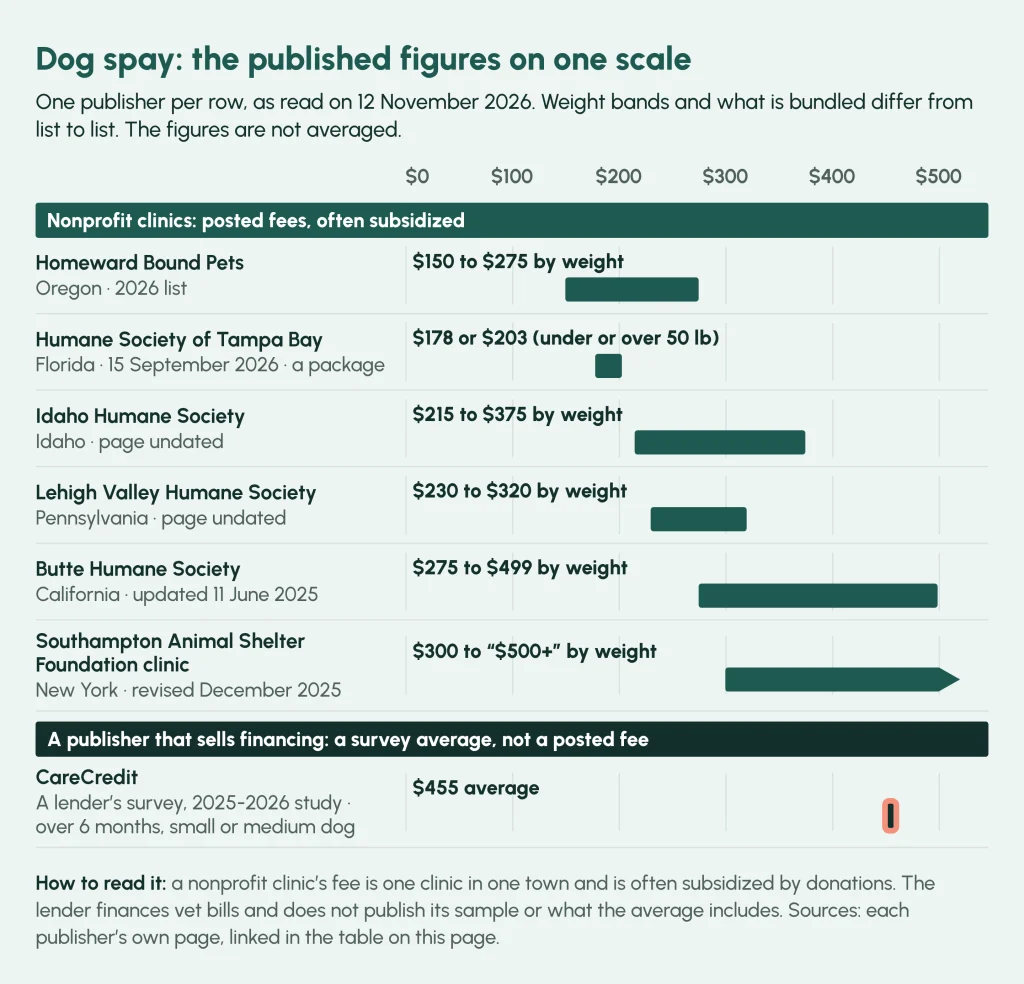
| Dog spay | $150 to $275 by weight, Homeward Bound Pets ($20 more for owners outside its county). $178 or $203 (under or over 50 lb), Humane Society of Tampa Bay, as a package with pain medicine, a rabies shot and a cone (published 15 September 2026). $215 to $375 by weight, Idaho Humane Society. $230 to $320 by weight, Lehigh Valley Humane Society. $275 to $499 by weight, Butte Humane Society. $300 to “$500+” by weight, Southampton Animal Shelter Foundation clinic. All nonprofits. | $455 (over 6 months, small or medium dog) | Dog spay and neuter cost |
| Cat spay | $95, Idaho Humane Society. $100, Homeward Bound Pets. $105, Humane Society of Tampa Bay (package). $160 or $170 by age, Southampton Animal Shelter Foundation clinic. $200, Lehigh Valley Humane Society. $213, Butte Humane Society. All nonprofits. | $353 (over 6 months) | Cat spay and neuter cost |
| Dog dental cleaning | “Start at $250”, Houston Humane Society, with a $50 consultation, extractions and extra medicines not included. $500 plus a $46 consultation, Lehigh Valley Humane Society. $575, Humane Society of Manatee County, Bradenton, Florida, including the exam, sedation, bloodwork and minor extractions ($600 from 1 January 2027). All nonprofits. | $379 (“routine dental cleaning”) | Dog teeth cleaning cost |
| Cat dental cleaning | $500, Humane Society of Manatee County ($525 from 1 January 2027). The Houston and Lehigh Valley lists above don’t split dogs from cats. Only two published sources name a cat price. | $395 | Cat teeth cleaning cost |
| Emergency exam (the fee to be seen, before any treatment) | $175 plus a $15 cleaning and safety fee, Colorado State University. $210 after hours, University of Tennessee (sheet updated 30 April 2026). $292, NC State. All teaching hospitals. | Dog ER exam $135; cat ER base fee $143 | Emergency vet cost |
| X-rays | $128 for multiple views, Lehigh Valley Humane Society (nonprofit). $298 plus $85 sedation for a knee series, Zoomies Veterinary Surgery & Dental, Tipp City, Ohio (private; prices effective October 2026). | Dog $172; cat $158 (two to three views) | Dog X-ray cost |
| TPLO (a knee surgery for dogs), per knee | $3,400 up to 90 lb or $3,900 over, “all inclusive” except the 8-week X-rays ($200 more), Surgery Vet, Fort Walton Beach, Florida. $4,000 fixed, from first exam to follow-up visits, CVETS, Columbia, South Carolina (its page says extra anesthesia screening or nonstandard implants may cost more). $4,386 to $5,775 from first consultation to last recheck, Zoomies Veterinary Surgery & Dental, Tipp City, Ohio. All private. An insurer, Lemonade, puts it at “roughly $6,000 to $10,000 per leg” (page updated 13 October 2026). | $3,525 | TPLO surgery cost |
| Cataract surgery, one eye | $3,200 to $4,300, University of Tennessee (updated 5 June 2026; the first exam and workup are $500 to $1,000 more, and rechecks at about $110 each are not included). $4,900 to $5,500, University of Missouri (as of March 2025; the eye tests before surgery are included, a first exam at about $350 and rechecks at about $300 each are not). Both teaching hospitals. | $3,782 per eye | Dog cataract surgery cost |
| Euthanasia at a clinic | $70 to $145 by size, Humane Society for Tacoma and Pierce County, Washington (group cremation included if wanted; the pet is signed over to the shelter and the owner is not present). $115, Suncoast Humane Society, Englewood, Florida. “Starting at $135”, Humane Society of Greater Miami. All nonprofits; we found no private general practice that posts this fee. | No figure on the page | Pet euthanasia cost |
| Cremation with the ashes returned | $115 to $208 by size, Humane Society for Tacoma and Pierce County. $90 to $295 by weight, Butte Humane Society. $225 to $275 by weight, Humane Society of Greater Miami. All nonprofits. | No figure on the page | Pet cremation cost |
Some care has almost no published prices. For an MRI we found one insurer’s range and no hospital or clinic that posts a fee, and we say so on the dog MRI cost page instead of presenting one interested source as the answer. The other procedure pages follow the same method: dog ACL surgery (TPLO beside the other knee repairs), hip dysplasia surgery, pyometra surgery, other common dog surgeries and in-home euthanasia. The surgery and test pages are grouped under surgery, tests and emergencies.
Why one procedure has many prices
The table shows gaps of two and three times for the same named procedure. Most of the gap comes from four things you can check on any estimate.
- What is bundled. The Manatee County clinic’s $575 dental includes the exam, sedation, pre-operative bloodwork and minor extractions. The Houston clinic’s “$250 and up” leaves out the $50 consultation, extractions and extra medicines. The two figures don’t describe the same bill.
- Who is doing it. A nonprofit clinic funded partly by donations, a general practice, a specialist surgeon and a 24-hour emergency hospital price the same word differently. The teaching hospitals’ emergency exam fees above are roughly two to five times the nonprofit clinics’ routine exam fees.
- The animal. Many lists price by weight. The Idaho Humane Society’s dog spay runs from $215 (up to 30 lb) to $375 (95 lb or more), and it lists add-ons of $80 for a dog in heat and $95 for a pregnant one.
- What “from” means. “Starting at” prices and survey averages are not ceilings. The lender’s survey says fees such as an in-office visit may be charged on top of its averages.
So a published figure is a way to read your own estimate, not a verdict on it. A higher estimate may simply include more; a lower one may leave lines out. Which care is right for your pet is your vet’s call, not a price list’s.
How fast vet prices have risen
The Bureau of Labor Statistics (BLS) tracks vet prices inside the Consumer Price Index, in a series called “Veterinarian services in U.S. city average, all urban consumers, not seasonally adjusted” (series CUUR0000SS62054, December 1997 = 100). It is a different series from “pet services” (CUUR0000SS62053), which covers things like grooming and boarding and is sometimes quoted by mistake. The index levels below are BLS’s; the percentages are our arithmetic, each one the later level divided by the earlier one.
| Month | Veterinarian services index | All items index (CUUR0000SA0) |
|---|---|---|
| September 2016 | 246.488 | 241.428 |
| September 2021 | 288.913 | 274.310 |
| September 2025 | 399.189 | 324.800 |
| September 2026 | 417.438 | 336.940 |
| Change in 1 year | +4.6% | +3.7% |
| Change in 5 years | +44.5% | +22.8% |
| Change in 10 years | +69.4% | +39.6% |
In plain terms: vet care that cost $100 in September 2016 cost about $169 in September 2026, where a basket of everything households buy went from $100 to about $140. Over five years, vet prices rose about twice as fast as prices overall.
We use September because it is the latest month with a clean year-on-year comparison. October 2026 is out (418.826 for vet services, 337.511 for all items), but BLS has no October 2025 figure to compare it with: the series shows that month as “Data unavailable due to the 2025 lapse in appropriations”, the federal shutdown. The November 2026 figures are due in mid-December 2026.
Year by year
| 12 months to September | Veterinarian services | All items |
|---|---|---|
| 2017 | +2.2% | +2.2% |
| 2018 | +2.5% | +2.3% |
| 2019 | +4.3% | +1.7% |
| 2020 | +4.0% | +1.4% |
| 2021 | +3.2% | +5.4% |
| 2022 | +11.6% | +8.2% |
| 2023 | +7.5% | +3.7% |
| 2024 | +6.7% | +2.4% |
| 2025 | +7.8% | +3.0% |
| 2026 | +4.6% | +3.7% |
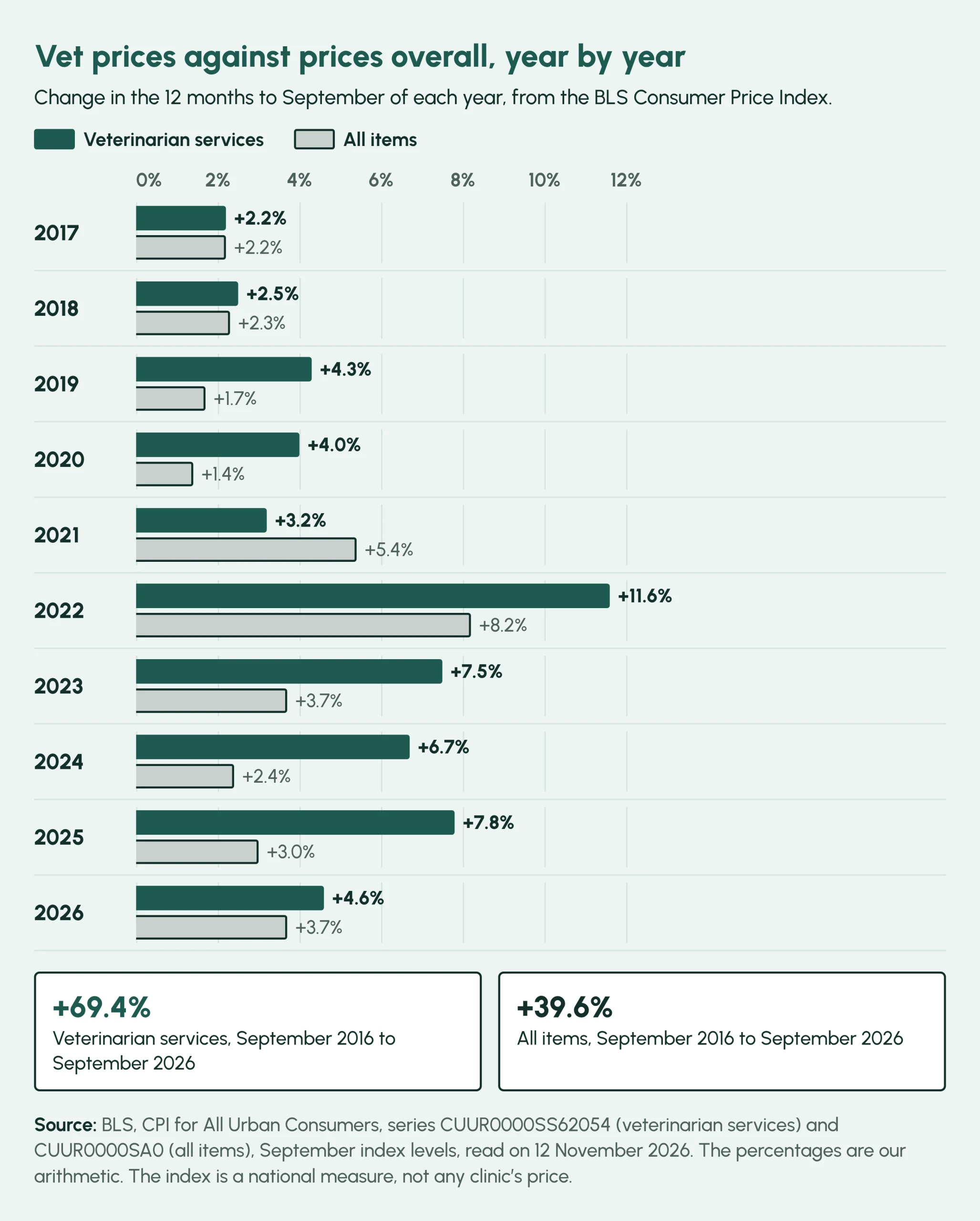
Two things stand out. Vet prices rose faster than prices overall in eight of the ten years (2017 was level to one decimal place, and 2021 was slower). And the gap opened after 2021: the 2022 jump of 11.6% was the largest in the decade, and the three years after it each ran at roughly twice the overall rate or more. The latest year, 4.6%, is the slowest since 2021 but still above the all-items rate.
Keep in mind what the index is. It tracks the prices charged for vet services in cities across the country. It is not what your clinic will charge, and it says nothing about any one procedure.
What households spend in a year
Prices are one thing; what people actually spend is another. BLS’s Consumer Expenditure Survey for 2025 (Table 2500, published October 2026) puts average spending on vet services at $361 per household for the year, out of $997.05 on pets in all. The rest of the pet total was $356.69 on pet food, $186.75 on buying pets, supplies and medicine, and $92.61 on pet services.
Read that $361 with three cautions, all from the table itself:
- It is an average over every household, with or without a pet. BLS calls them consumer units, about 138 million of them. A household that has a dog or a cat spends more than the average; one with no pet spends nothing.
- It is a rough estimate. BLS gives the figure a relative standard error of 19.38%, which is wide. The standard error is $69.95, so the usual 95% margin runs from about $224 to about $498. “About $360, give or take a lot” is the honest reading.
- Vet bills are lumpy. Only 1.78% of households reported a vet expense in a given survey week. Most weeks cost nothing; one visit can cost a great deal. An average hides that.
You may also see higher figures from the American Veterinary Medical Association (AVMA), a professional body for vets. Its pet ownership page gives average yearly spending on veterinary care of $595 for households with dogs and $426 for households with cats in 2026, from what it describes as an opt-in online survey of 7,547 people in early spring 2026. We read that page in an Internet Archive copy dated 27 October 2026, because the live page blocks automated reading. It measures a different group (pet-owning households, self-selected) from BLS’s (all households, sampled), so the two aren’t in conflict and can’t be set side by side as a trend.
Why prices keep rising: what the record shows
BLS publishes the rise. It does not publish a breakdown of causes, and we found no federal source that splits the increase into wages, drugs, equipment, ownership or anything else. Anyone who gives you a single cause is offering an opinion. Here is what the public record does contain.
What the people cost
Part of every vet bill pays for trained people’s time. BLS’s Occupational Employment and Wage Statistics for May 2025 (the national table, read on 12 November 2026) puts the mean wage for veterinarians at $68.60 an hour ($142,680 a year) and the median at $62.55, across 83,900 jobs. For veterinary technologists and technicians the mean is $23.61 an hour ($49,120 a year) and the median $22.78, across 129,140 jobs. Those are levels for one year, before a clinic’s rent, equipment, supplies, insurance and support staff. We haven’t compared them with earlier years, so we make no claim here about how fast pay has grown. The May 2026 figures are due in spring 2027.
Specialists are scarce, by the FTC’s account
In its merger reviews, the Federal Trade Commission (FTC) has described specialty and emergency care as hard to enter. Its 2022 analysis says:
“veterinary specialists are often in short supply, and recruiting them to move to a new area frequently takes more than two years”
FTC, analysis of the JAB/Ethos consent orders, 87 Fed. Reg. 48026 (5 August 2022), read on 12 November 2026
The same document says that building a new specialty or emergency hospital and equipping it “can be expensive and time consuming”. That is the agency’s description of specialty and emergency markets, not of the local clinic that does checkups and vaccines.
More clinics belong to large groups
The FTC has stepped into several vet hospital mergers. These are background, and none of them shows what moved the national index.
- Mars and VCA, 2017. A deal the FTC valued at about $9.1 billion. The proposed consent agreement required Mars to sell 12 specialty or emergency clinics in ten local markets, from Seattle to New York (82 Fed. Reg. 42552, 8 September 2017).
- JAB (Compassion-First/NVA) and SAGE, 2022. About $1.1 billion; six clinics to be sold, with FTC prior approval required for nearby purchases in Texas and California (87 Fed. Reg. 38153, 27 June 2022).
- JAB (Compassion-First/NVA) and Ethos, 2022. About $1.65 billion; five clinics to be sold, with prior approval required in California, Colorado, Virginia, Maryland and the District of Columbia (87 Fed. Reg. 48026, 5 August 2022).
In the Ethos analysis the FTC wrote of “a growing trend towards consolidation in the emergency and specialty veterinary services markets across the United States in recent years by large chains”. In each case it alleged that, without the clinic sales, the merger would make it more likely that customers in those particular local markets paid higher prices or got lower quality. Those are allegations about named cities, settled by agreement before any court ruled on them. We read the Federal Register notices of the proposed agreements, not the final orders. They are not a finding that group ownership raised vet prices nationally, and we don’t claim it did.
What we can’t tell you
How much of the rise comes from pay, from drug and equipment costs, from who owns the clinic, or from more advanced care being offered: no primary source we could read measures it. We would sooner leave that blank than fill it with a guess.
How to read an estimate
An estimate is the clinic’s written forecast of a bill before the work, usually as a low and a high figure. An invoice is the bill for what was actually done. The gap between them is where surprises live, so the useful question isn’t “is this number high?” but “what is in it?”.
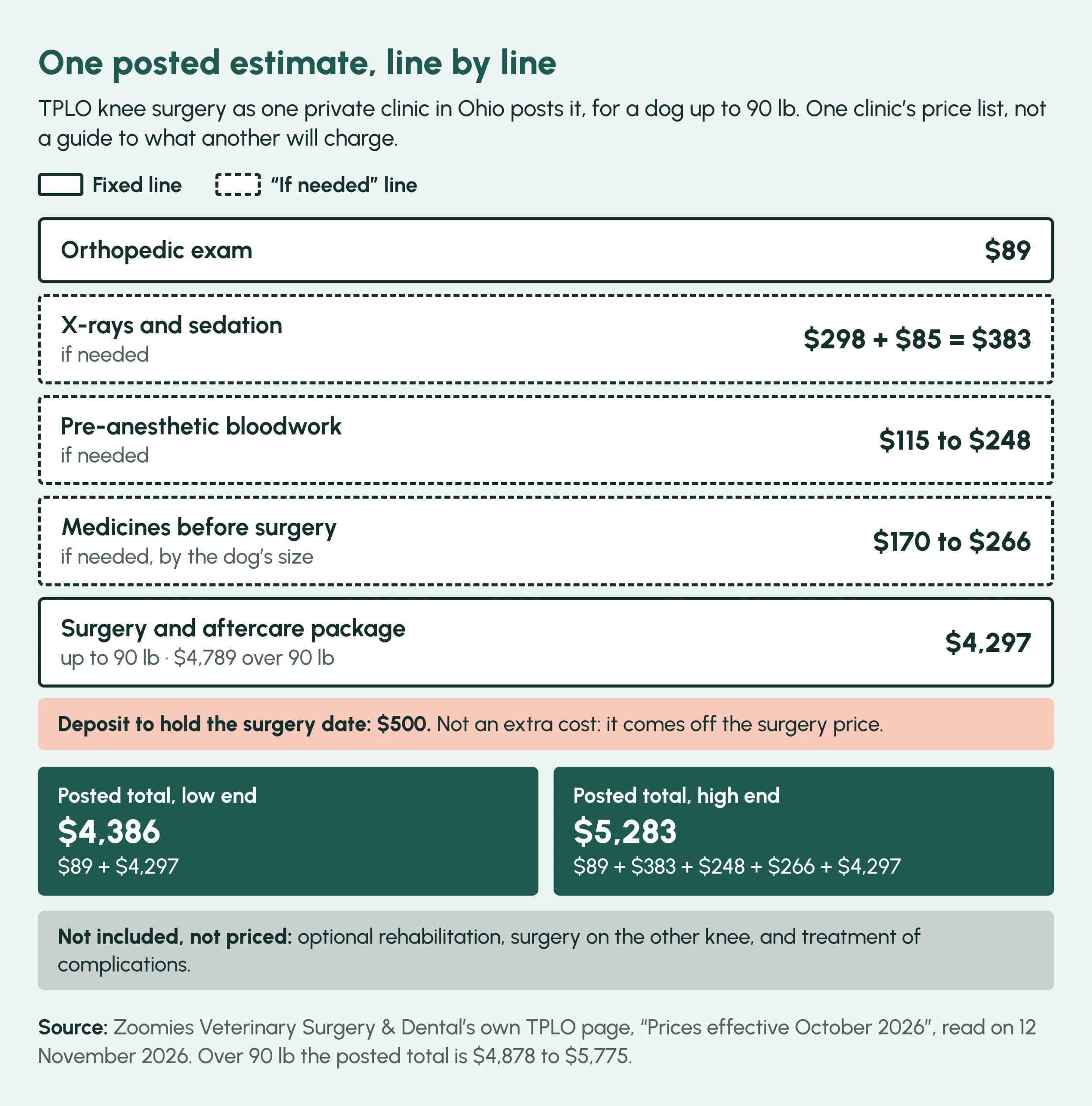
One private clinic, Zoomies Veterinary Surgery & Dental in Tipp City, Ohio, posts its TPLO knee surgery pricing line by line (prices effective October 2026, read on 12 November 2026). We use it here because it shows the parts of an estimate in the open. It is one clinic’s price list, not a guide to what yours will charge.
| Line | Posted price | What to notice |
|---|---|---|
| Orthopedic exam | $89 | The consultation is billed apart from the surgery. |
| X-rays and sedation, if needed | $298 + $85 = $383 | An “if needed” line. The page says recent X-rays from your own vet may do. |
| Pre-anesthetic bloodwork, if needed | $115 to $248 | A range, because the panel differs by dog. The page says recent bloodwork may not need repeating. |
| Medicines before surgery, if needed | $170 to $266 | Priced by the dog’s size. |
| Deposit to hold the surgery date | $500 | Not an extra cost: it comes off the surgery price. |
| Surgery and aftercare package | $4,297 (up to 90 lb) or $4,789 (over 90 lb) | One price by weight band. The page says it covers anesthesia and monitoring, IV fluids, pain control, the implants, X-rays after surgery and the 2-week and 8-week rechecks. |
| Posted total | $4,386 to $5,283 (up to 90 lb); $4,878 to $5,775 (over 90 lb) | $89 + $4,297 = $4,386 at the low end. At the high end, $89 + $383 + $248 + $266 + $4,297 = $5,283. |
| Not included | Not priced | Optional rehabilitation, surgery on the other knee, and treatment of complications. |
Almost every estimate has the same anatomy, whatever the procedure:
- A fee to be seen (exam, consultation or emergency fee), often separate from everything else.
- Tests before the work, such as bloodwork before anesthesia (called pre-anesthetic bloodwork) and X-rays.
- The procedure itself, sometimes with anesthesia and monitoring inside the price and sometimes as their own lines.
- “If needed” lines, which is why most estimates are a range.
- Things to take home: medicines, a cone.
- Aftercare: a hospital stay, recheck visits, follow-up X-rays. Included in some prices, extra in others.
- Money terms: a deposit, when the balance is due, and what happens if the bill passes the high figure.
Our vet estimate builder lays out these lines for common procedures, with the lowest and highest published figure for each and its source, so you can hold a real estimate against it line by line. It gives a range, never one price, and your vet’s written estimate is what counts.
Is a vet required to give you an estimate?
You can always ask for a written, itemized estimate. Whether the vet has to give one is another matter: in the ten states we searched, we found a legal duty in only one, and only for emergencies.
- Texas, emergency care only. Texas Occupations Code section 801.3581 (in force since 1 September 2023, read on 12 November 2026) tells the state veterinary board to adopt rules requiring a vet to disclose “a description of the proposed treatment” and “the estimated price of the proposed treatment” before giving emergency treatment, after a reasonable chance to assess the animal. The board’s rule, 22 Texas Administrative Code section 573.83 (effective 13 June 2024, 49 TexReg 4054; read on the Texas Secretary of State’s rules site on 12 November 2026), defines emergency care as care for an animal that, in the vet’s reasoned opinion, has a life-threatening condition needing immediate treatment. It requires the vet to disclose the proposed treatment, “with reasonable options, if any”, and the estimated price, and to update the disclosure before continuing if the animal’s condition changes. It does not cover routine care.
- Other states. A keyword search on 11 November 2026 of the veterinary laws and board rules we had open for California, Florida, New York, Pennsylvania, Illinois, Ohio, Georgia, North Carolina and Michigan found no general duty to give a written estimate for routine care. That was a search of those texts, not a full reading of every law and rule (in Pennsylvania only the board’s rules were searched, and in Michigan only the statute), so treat it as “none found”, not as “no such rule”. The other 40 states and DC were not read.
- The profession’s own ethics code. The AVMA’s Principles of Veterinary Medical Ethics say that, to help clients decide, vets “should share” their findings, recommended tests and treatment, the outlook, the risks and the “estimated cost of services”, and that as new costs come up vet and client “should confer and reach agreement” on continued care and “responsibility for fees”. That is a professional body’s policy, not law, and its word is “should”. We read it in an Internet Archive copy dated 13 October 2026.
Hospitals also set their own practice. NC State’s emergency page says a team member “will discuss an estimate with you before major diagnostics or treatment whenever possible”, and Colorado State’s says it provides an estimate after the first exam. For what the law says when a bill goes unpaid, see what a vet can do about an unpaid bill, state by state.
Paying the bill
The estimate is the price. What you pay out of pocket, and when, depends on three more things, each with its own page under paying the vet.

If you have pet insurance
With pet insurance you generally pay the clinic and then claim money back, less the parts the policy doesn’t cover, a deductible (the amount you pay before the policy pays) and your share of the rest. The order of that subtraction changes the answer, and policies differ. Take an example bill of $6,000, all of it covered, with a $500 deductible, 80% reimbursement and $5,000 of annual limit left:
| Order the policy uses | The sum | Policy pays | You pay |
|---|---|---|---|
| Deductible first | ($6,000 − $500) × 80% | $4,400 | $1,600 |
| Percentage first | ($6,000 × 80%) − $500 | $4,300 | $1,700 |
The pet insurance payout calculator runs both orders on your own bill, and how pet insurance works explains each term. Whether insurance pays for itself on your numbers is a separate sum, in the break-even calculator; it is arithmetic, not advice.
If you need time to pay
Ask the clinic first what it offers, because policies differ sharply: the University of Tennessee’s emergency sheet says plainly that “individualized payment plans are not available”, while the Idaho Humane Society’s price list says outside financing is accepted and in-house financing “may be available” for those who don’t qualify. Vet payment plans covers what to ask. If you are offered a medical credit card or loan, vet financing explains the terms, and the deferred interest calculator shows what a “no interest if paid in full” offer costs if a balance is left when the promotion ends.
If you can’t cover it
Help with vet bills lists where assistance comes from and its limits. Tell your vet what you can afford; what care fits that budget is a conversation for the two of you, and your vet decides what is right for your pet.
Your next step
- Ask for a written, itemized estimate with a low and a high total, before the work if there is time.
- Ask what is in it and what isn’t: the exam fee, bloodwork, anesthesia, X-rays, the hospital stay, take-home medicines, the cone and recheck visits.
- Ask which lines are “if needed” and who decides, and whether the clinic will call you before going past the high figure.
- Ask about money: the deposit, when the balance is due, and what payment options the clinic accepts.
- If you are insured, check the deductible you have left, your reimbursement percentage, your limits, any waiting period or exclusion that applies, and which order of deduction your policy uses.
- Before signing for credit, read the promotion’s end date, the interest rate after it, and whether interest is deferred.
- Compare line by line, not total to total, with the published figures on the page for your procedure.
How we choose and label price sources is set out in how we estimate.
Sources checked on 12 November 2026. Posted fees and published estimates are from the named publishers’ own pages on that date and are not quotes. CPI figures are BLS index levels through October 2026 with our percentage arithmetic; the next release is due in mid-December 2026. Consumer Expenditure figures are for 2025; wage figures are for May 2025. The AVMA pages were read in dated Internet Archive copies. Texas section 801.3581 and rule 573.83 were read in the state’s official text. By The Paw Bill.
Sources
- BLS CPI-U, Veterinarian services, series CUUR0000SS62054 (index levels to October 2026; read 12 Nov 2026)
- BLS CPI-U, All items, series CUUR0000SA0 (read 12 Nov 2026)
- BLS Consumer Expenditure Survey 2025, Table 2500, all consumer units (October 2026)
- BLS Occupational Employment and Wage Statistics, May 2025, national table (veterinarians 29-1131; veterinary technologists and technicians 29-2056; read 12 Nov 2026)
- FTC: Mars, Incorporated and VCA Inc., analysis to aid public comment, 82 FR 42552 (8 Sep 2017)
- FTC: JAB/SAGE Veterinary, analysis of consent orders, 87 FR 38153 (27 June 2022)
- FTC: JAB/Ethos Veterinary Health, analysis of consent orders, 87 FR 48026 (5 Aug 2022)
- Texas Occupations Code ch. 801, sec. 801.3581 (price transparency for emergency care)
- 22 Tex. Admin. Code 573.83, Texas Secretary of State rules site (official; eff. 13 June 2024, 49 TexReg 4054; read 12 Nov 2026)
- AVMA Principles of Veterinary Medical Ethics (Internet Archive copy, 13 Oct 2026): a professional body's policy, not law
- AVMA U.S. pet ownership statistics (Internet Archive copy, 27 Oct 2026): opt-in survey
- CareCredit (Synchrony), 2025-2026 Synchrony Average Procedural Cost Study (lender-commissioned survey)
- Southampton Animal Shelter Foundation clinic price list 2026, revised December 2025 (nonprofit, New York)
- Idaho Humane Society hospital price list (nonprofit, undated)
- Butte Humane Society pricing (nonprofit, Chico CA; list updated 11 June 2025)
- Homeward Bound Pets price list for 2026 (nonprofit, McMinnville OR)
- Lehigh Valley Humane Society clinic services (nonprofit, Allentown PA, undated)
- Humane Society of Tampa Bay spay and neuter fees (nonprofit; published 15 Sep 2026)
- Houston Humane Society dental care (nonprofit, undated)
- Humane Society of Manatee County dental services (nonprofit, Bradenton FL)
- Colorado State University Veterinary Teaching Hospital, emergency page
- University of Tennessee CVM, after-hours emergency sheet (updated 30 Apr 2026)
- NC State Veterinary Hospital, emergency page
- Zoomies Veterinary Surgery & Dental TPLO page (private clinic, Tipp City, Ohio; prices effective October 2026)
- Surgery Vet TPLO page (private practice, Fort Walton Beach FL, undated)
- CVETS TPLO page (private specialty hospital, Columbia SC, undated)
- Lemonade (insurer) TPLO cost page, updated 13 Oct 2026
- University of Tennessee CVM cataract pre-referral sheet (updated 5 June 2026)
- University of Missouri Veterinary Health Center cataract handout (April 2025; estimate as of March 2025)
- Humane Society for Tacoma and Pierce County end-of-life services (nonprofit, undated)
- Suncoast Humane Society owner-requested euthanasia (nonprofit, Englewood FL, undated)
- Humane Society of Greater Miami humane euthanasia (nonprofit, undated)