Pet insurance pays back more than it costs only if the vet bills it covers turn out higher than a figure you can work out before you buy. With the calculator’s example numbers ($50 a month rising 10% a year, a $250 annual deductible, 90% reimbursement, over five years), payouts match premiums when covered bills run about $1,064 a year, or about $1,092 if the policy takes its percentage before the deductible. Below that you pay in more than you get back; above it, less. Nobody can tell you which side your pet will land on. The calculator above does the sum on your own numbers, and this page shows every step. It is part of our guide to how pet insurance works.
General information about costs, insurance and the rules, not veterinary, legal, insurance, tax or financial advice. Your vet decides what care is right for your pet; your policy’s wording and your insurer decide what a claim pays; your card or loan agreement decides what credit costs.
This is arithmetic, not advice. The calculator gives estimates in dollars and years. It doesn’t say whether to insure, and it can’t know what your pet’s bills will be.
What you enter
Four numbers come from a quote or from the first page of your policy (the declarations page). The rest are your own guesses, and the answer is only as good as they are.
| Input | Where it comes from | Example the calculator opens with |
|---|---|---|
| Monthly premium now | Your quote or latest bill | $50 (a round number, not a quote and not an average) |
| Yearly premium rise | Your guess. Nothing in a policy fixes it | 10% (not a forecast) |
| Years to look at | Your choice, 1 to 20 | 5 |
| Deductible type | Declarations page: annual, or per condition | Annual |
| Deductible | Declarations page: the amount you pay before the policy pays | $250 |
| New conditions over those years | Your guess; used only with a per-condition deductible | 2 (not used in the example, which has an annual deductible) |
| Reimbursement percentage | Declarations page: the share of covered charges the policy pays | 90% |
| Annual limit | Declarations page: the most the policy pays in a policy year (0 if none) | $5,000 |
| Covered vet bills in an ordinary year | Your guess, counting only bills the policy would cover | $500 |
| Covered vet bill in one bigger year, and which year | Your guess, or a figure from a written estimate | $5,000 in year 3 |

“Covered” matters, because policies exclude things. Pets Best’s Maine sample booklet (read 12 November 2026), as one example of the terms, excludes pre-existing conditions and preventive care such as wellness exams and vaccinations, applies waiting periods, and covers office visit and exam fees only if the declarations page says so. Your own policy’s list may differ. Enter only the bills your policy would pay toward. Our page on what pet insurance covers and excludes goes through the usual lines, and the pre-existing conditions page explains that exclusion.
What it works out
- Total premiums over the years you chose, with your yearly rise applied, and the premium in the first and last year.
- Total payouts, worked twice: deductible first and percentage first (explained below).
- Payouts minus premiums, in total and per year on average. A minus sign means you paid in more than came back.
- Premiums plus your share of the bills: everything you would spend with the policy.
- The steady yearly bill at which payouts match premiums: the break-even figure.
- The same premiums set aside instead, with no interest: what would be left after paying the bills yourself, and where that fund would stand at the end of the year the bigger bill arrives.
- Whether the annual limit was reached.
No output says “worth it” or “not worth it”. Whether a known monthly cost is a good trade for protection against a bill you may never get is a judgment about your own money and nerves, and no sum settles it.
The formula
- Premiums. Year 1 is 12 times the monthly premium. Each later year is the year before, plus your rise. The total is the sum.
- Each year’s payout, from that year’s covered bill, the deductible and the reimbursement percentage, in one of two orders:
Deductible first: (bill − deductible) × percentage.
Percentage first: bill × percentage − deductible.
Never below zero, and never above the annual limit. - Deductible type. Annual: the deductible comes off every year. Per condition: it comes off once for each new condition you entered, at most one a year, starting with the bigger year.
- Difference. Total payouts minus total premiums.
- Break-even bill. The same bill every year at which total payouts equal total premiums. With an annual deductible: deductible first, average yearly premium ÷ percentage + deductible; percentage first, (average yearly premium + deductible) ÷ percentage.
- Savings line. Total premiums minus the bills entered, no interest.
Both orders of deduction exist in real policies. Among the public sample policies we read on 12 November 2026, MetLife Pet’s Ohio sample (form PET21-01-V) prints a claim example that takes the deductible first: a $2,000 treatment, less a $250 deductible, times a covered percentage of 100%, pays $1,750. Pets Best’s accident-only sample (form IAIC-PB10001-ACC) prints one that takes the percentage first: $1,900 of eligible charges times 90% is $1,710, less a $250 deductible, pays $1,460. Its Maine disclosure (form APIC-PBI0012-ME) states the same formula in words. Those are examples of a term, not a count of the market. Percentage first pays less by the deductible times your own share: $25 on a $250 deductible at 90%, each time the deductible is used in full. Your policy’s formula disclosure says which order yours uses; the payout calculator works a single bill both ways.
Worked example
This is arithmetic, not advice. General information about costs, insurance and the rules, not veterinary, legal, insurance, tax or financial advice. Your vet decides what care is right for your pet; your policy’s wording and your insurer decide what a claim pays; your card or loan agreement decides what credit costs.
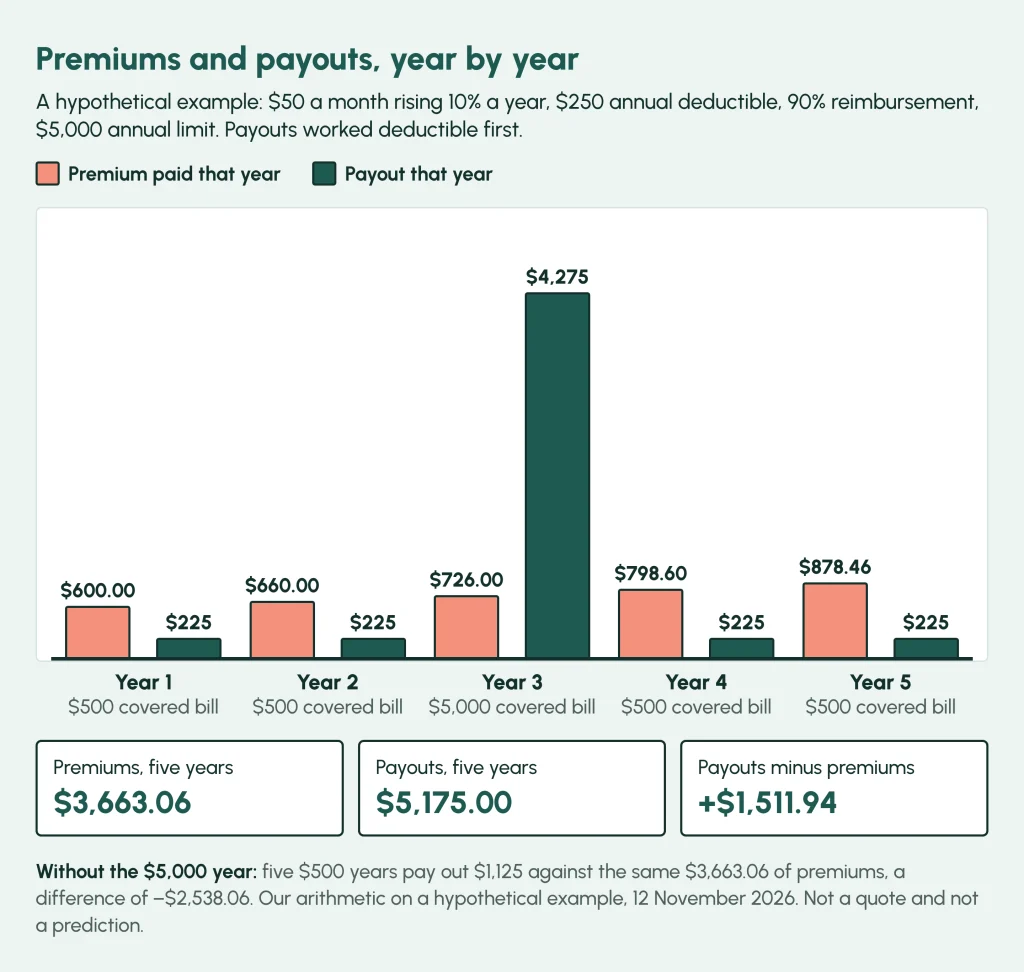
The calculator opens on this example: $50 a month rising 10% a year, a $250 annual deductible, 90% reimbursement, a $5,000 annual limit, $500 of covered bills in an ordinary year and one $5,000 covered bill in year 3.
| Year | Premium | Covered bill | Payout, deductible first | Payout, percentage first | Running payouts minus premiums (deductible first) |
|---|---|---|---|---|---|
| 1 | $600.00 | $500 | (500 − 250) × 0.9 = $225 | 500 × 0.9 − 250 = $200 | −$375.00 |
| 2 | $660.00 | $500 | $225 | $200 | −$810.00 |
| 3 | $726.00 | $5,000 | (5,000 − 250) × 0.9 = $4,275 | 5,000 × 0.9 − 250 = $4,250 | +$2,739.00 |
| 4 | $798.60 | $500 | $225 | $200 | +$2,165.40 |
| 5 | $878.46 | $500 | $225 | $200 | +$1,511.94 |
| Total | $3,663.06 | $7,000 | $5,175.00 | $5,050.00 |
- Payouts minus premiums: $5,175.00 − $3,663.06 = +$1,511.94 deductible first; $5,050.00 − $3,663.06 = +$1,386.94 percentage first.
- Premiums plus your share of the bills: $3,663.06 + $7,000 − $5,175.00 = $5,488.06 deductible first; $5,613.06 percentage first. Without a policy the same bills cost $7,000.
- Break-even bill: average yearly premium $3,663.06 ÷ 5 = $732.61. Deductible first: $732.61 ÷ 0.9 + $250 = $1,064.01 a year. Percentage first: ($732.61 + $250) ÷ 0.9 = $1,091.79 a year.
- Savings line: $3,663.06 set aside, less $7,000 of bills, leaves −$3,336.94. At the end of year 3 the fund would hold $1,986 of premiums against $6,000 of bills so far: $4,014 short.
Take the $5,000 year out and the picture turns over. Five ordinary $500 years bring back $1,125 (deductible first) or $1,000 (percentage first) against the same $3,663.06 of premiums: a difference of −$2,538.06 or −$2,663.06. Nothing about the policy changed. Only the bills did.
One surgery, four published sources
The size of the one big bill decides most of the answer, so here is the same example with real published figures for one operation in the bigger year: TPLO, a knee surgery for dogs. The figures are published estimates and posted fees, each from one named source, and they are far apart. They aren’t a guide to what care a pet needs. Your vet decides what is right for your pet.
| Source and who publishes it | Published figure | Date | Why it may lean |
|---|---|---|---|
| Bernardo Heights Veterinary Hospital, a private clinic in San Diego | $2,600, for dogs of about 40 to 89 lb | Undated page; read 12 Nov 2026 | One clinic’s posted fee, which the page calls all inclusive (8-week recheck and X-rays included); pre-operative diagnostics are discounted, not included |
| CareCredit, a medical credit card issuer (a lender’s figure) | $3,525 average per knee | Its 2025-2026 commissioned cost study; read 12 Nov 2026 | Finances vet bills; method not published; an office visit may be extra |
| Zoomies Veterinary Surgery & Dental, a private surgery practice in Tipp City, Ohio | $4,386 to $5,283 in all, dogs up to 90 lb | Page says “Prices effective October 2026”; read 12 Nov 2026 | One clinic’s itemized total: consultation stage $89 to $986 plus surgery and aftercare package $4,297; rehabilitation and complications not included |
| Lemonade, an insurer (an insurer’s figure) | “roughly $6,000 to $10,000 per leg” | Page updated 13 Oct 2026; read 12 Nov 2026 | Sells cover against high bills; not itemized, no source given |
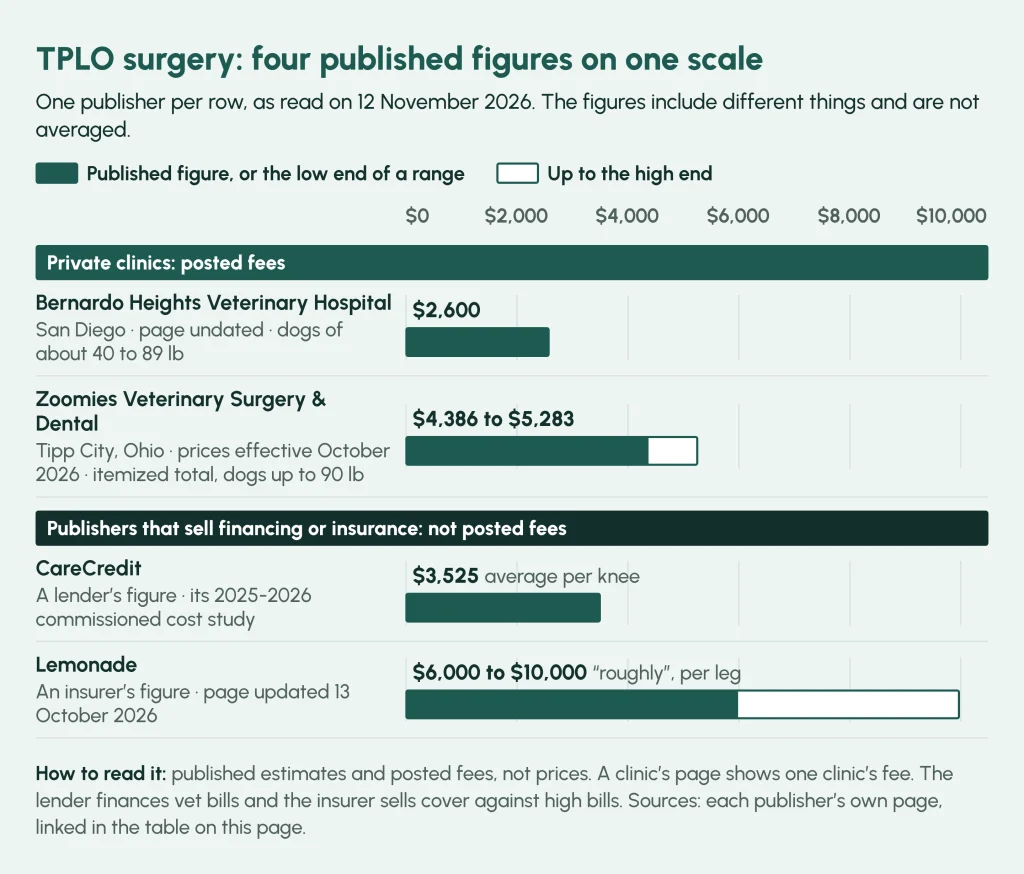
Our TPLO surgery cost page sets out what each figure includes. Here each one goes into year 3 of the example above, with everything else unchanged and the whole bill treated as covered.
| Bill in year 3 | Total payouts, deductible first | Payouts minus premiums, deductible first | Total payouts, percentage first | Payouts minus premiums, percentage first | Same premiums set aside, after the bills |
|---|---|---|---|---|---|
| No bigger bill ($500) | $1,125.00 | −$2,538.06 | $1,000.00 | −$2,663.06 | +$1,163.06 |
| $2,600 (one clinic’s posted fee) | $3,015.00 | −$648.06 | $2,890.00 | −$773.06 | −$936.94 |
| $3,525 (a lender’s survey average) | $3,847.50 | +$184.44 | $3,722.50 | +$59.44 | −$1,861.94 |
| $5,283 (top of one clinic’s itemized range) | $5,429.70 | +$1,766.64 | $5,304.70 | +$1,641.64 | −$3,619.94 |
| $6,000 (low end of an insurer’s estimate) | $5,900.00 | +$2,236.94 | $5,800.00 | +$2,136.94 | −$4,336.94 |
| $10,000 (high end of an insurer’s estimate) | $5,900.00 | +$2,236.94 | $5,800.00 | +$2,136.94 | −$8,336.94 |
Two things show in the last two rows. The $5,000 annual limit caps the year-3 payout, so a $10,000 bill brings back no more than a $6,000 one, and the extra $4,000 is yours. And in a real claim the whole bill is rarely “covered charges”: Pets Best’s Maine sample booklet, as an example of the terms, makes exam fee cover depend on the declarations page, sets a 30-day waiting period for cruciate ligament events (in its Maine disclosure and endorsement; the base form prints six months), and excludes a condition on one side of the body when a matching pre-existing condition was on the other. Terms like these can shrink a payout or remove it. The cover-start checker shows when each kind of cover begins under the terms you enter.
What moves the answer
The premium rise
This input is easy to leave at zero, and it is the one the policy doesn’t fix. MetLife Pet’s Ohio sample policy says that when the policy is renewed the insurer may change the premium rates, with written notice at least 30 days before the policy period ends if they go up. Physicians Mutual’s sample policy (form P970) says the insurer may change the premium, the terms and the benefit limits at renewal, with notice. Both are examples of the term, read 12 November 2026.
None of the state pet insurance statutes read for our law table caps premium rises (checked 12 November 2026), and there is no federal pet insurance law. What such a statute can require is disclosure. Nebraska’s, read in full on 12 November 2026, makes an insurer tell consumers:
Whether the pet insurer reduces coverage or increases premiums based on the insured’s claim history, the age of the covered pet, or a change in the geographic location of the insured
Neb. Rev. Stat. 44-6505(1)(d), read 12 November 2026
So the disclosure document that comes with a policy under a law like Nebraska’s tells you whether claims, age or a move can raise the price. It doesn’t tell you by how much. Our table of pet insurance laws by state lists which states have such a law.
For a sense of scale, shown beside the input and not used as its default: industry data (NAPHIA, 2026 report, 2025 figures) put the average US accident and illness premium at $836 a year for dogs and $435 for cats in 2025, up 11.5% and 12.6% on 2024. NAPHIA is the pet insurers’ trade association. Its table for the last five years:
| Average annual premium, accident and illness, US | 2021 | 2022 | 2023 | 2024 | 2025 |
|---|---|---|---|---|---|
| Dogs | $625 | $640 | $675 | $749 | $836 |
| Change on the year before | +2.0% | +2.4% | +5.5% | +11.0% | +11.5% |
| Cats | $370 | $387 | $383 | $386 | $435 |
| Change on the year before | +0.8% | +4.7% | −1.1% | +0.9% | +12.6% |
Read those with care. They are market-wide averages, which NAPHIA says it builds from its members’ data and public filings, in places with actuarial estimates. They cover every age, breed, place and plan design at once, so they are not a quote, and the yearly change is not the rise on any one pet’s policy. Your own pet also gets a year older every year, which the average doesn’t. In the example, moving the rise from 10% to 0% cuts five years of premiums from $3,663.06 to $3,000. Our page on what pet insurance costs and why premiums rise covers the factors.

The deductible type
An annual deductible comes off once in each policy year. A per-condition deductible comes off once for each new condition and then not again for that condition. The only public document we read that describes one is an old Trupanion flyer from 2012, which says its deductible is applied once per condition over the life of the policy; treat it as a dated example of the term. The difference matters most for a condition treated year after year. Take $2,000 of covered bills a year for three years for one condition, a $500 deductible and 80%, deductible first: an annual deductible pays 3 × $1,200 = $3,600; a per-condition one pays $1,200 + $1,600 + $1,600 = $4,400. For several unrelated problems in one year it works the other way. Our explainer on deductibles, reimbursement and limits has more.
The annual limit
The limit is the most the policy pays in a policy year, and it doesn’t include the deductible (MetLife Pet’s Ohio sample defines it that way). It only bites in a big year. If the limit is lower than the average yearly premium needs it to be, no steady bill can break even, and the calculator shows $0 for the break-even bill and says why.
Vet prices
The calculator keeps your ordinary yearly bill flat. Vet prices haven’t been flat: the Bureau of Labor Statistics’ consumer price index for veterinarian services (series CUUR0000SS62054, not seasonally adjusted) stood at 399.189 in September 2025 and 417.438 in September 2026, a rise of 4.6% by our arithmetic. The latest figure, October 2026, is 418.826; BLS published no October 2025 figure because of the 2025 lapse in appropriations, so September is the latest month with a year-earlier match (read 12 November 2026; the November figure is due in mid-December 2026). If you look more than a few years ahead, a bill guess in today’s prices may be low. Our page on what vet care costs and why prices keep rising has the longer series.
The break-even bill
The break-even figure is the plainest way to see what a policy asks of you. It is the covered bill you would need every year for payouts to equal premiums. For one year with an annual deductible:
- Deductible first: yearly premium ÷ percentage + deductible.
- Percentage first: (yearly premium + deductible) ÷ percentage.
At $600 a year, a $250 deductible and 90%, that is $600 ÷ 0.9 + $250 = $916.67, or ($600 + $250) ÷ 0.9 = $944.44. Two things push it up: a rising premium and a higher deductible. A higher percentage pulls it down, but the percentage, the deductible and the premium are set together in a quote, so the terms can’t be judged one at a time.
A steady bill is a thinking tool, not how vet bills arrive. Bills can be small for years and then large in one, which is why the calculator also takes one bigger year. A policy with a low break-even bill can still return less than it cost if the large year never comes, and one with a high break-even bill can return several times its cost if it does.
Dogs and cats
The arithmetic is the same for a dog and a cat. The inputs differ. On the industry averages above (NAPHIA, 2026 report, 2025 figures: $836 a year for dogs, $435 for cats; averages over all policies, not quotes), a one-year break-even with a $250 deductible and 90% works out as follows.
| Yearly premium used | Break-even bill, deductible first | Break-even bill, percentage first |
|---|---|---|
| $836 (industry average, dogs, 2025) | 836 ÷ 0.9 + 250 = $1,178.89 | (836 + 250) ÷ 0.9 = $1,206.67 |
| $435 (industry average, cats, 2025) | 435 ÷ 0.9 + 250 = $733.33 | (435 + 250) ÷ 0.9 = $761.11 |
A lower premium means a lower break-even bill, and that is all the table shows. It doesn’t show that one species is the better case for insurance, because the bills differ too, and this page has no sourced figure for that. Use your own quote and your own vet’s prices. For an older animal the premium, any age conditions and the pre-existing exclusion all change the inputs; see pet insurance for older pets.
The same money in savings
One alternative is paying the premium into a savings account instead. The calculator’s savings line does that sum with no interest: total premiums, less the bills you entered. In the worked example it ends at −$3,336.94; with no bigger bill it ends at +$1,163.06.
The total hides the timing, so the calculator also shows where the fund stands at the end of the year you chose. A fund only holds what has been paid in so far. In the example the $5,000 bill arrives in year 3, when $1,986 has gone in and $1,000 has already gone out on ordinary bills. A policy’s annual limit doesn’t build up over time in the same way: it applies to covered claims once cover for that kind of claim has begun. Neither line counts interest earned on savings, or the cost of borrowing to fill a gap. If a bill would have to go on credit, the deferred interest calculator shows what a promotional plan costs when it isn’t cleared in time.
What the sum leaves out
- Exclusions and claim decisions. The calculator trusts your “covered” figure. Your policy’s wording and your insurer decide each claim.
- Waiting periods. Where a policy has waiting periods, a claim for something that first shows during one may not be paid (your policy’s wording decides), so the first weeks of year 1 may bring nothing back.
- Changing terms. It holds the deductible, percentage and limit steady. A policy can change them: MetLife Pet’s Ohio sample, for example, cuts the deductible by $50 at each renewal after a policy period with no claim payments, and puts it back after a paid claim.
- Routine care. Unless your policy includes it, check-ups, vaccines and the like cost the same with or without the policy, so leave them out of the bills you enter.
- Taxes, fees and interest. None are counted.
- Rounding. Results are rounded to the cent at the end, so a year-by-year sum of rounded premiums can differ by a cent or two.
One regulator said the underlying point long ago. The Illinois Department of Insurance’s consumer fact sheet “Pet Health Insurance”, dated August 2010 and still on a department web address when we read it on 12 November 2026, says:
As with other types of insurance, there is no guarantee that buying pet health insurance will save you money, and it is possible that you will pay more in premiums than you receive in benefits.
Illinois Department of Insurance, “Pet Health Insurance”, August 2010
The sheet is sixteen years old and we quote it only for that sentence, which is about arithmetic and hasn’t dated. It cuts both ways: a policy that returned less than it cost still stood ready to pay for a year that didn’t happen.
Your next step
- Get the four policy numbers in writing: deductible and its type, reimbursement percentage, annual limit, and the premium. They are on the quote and on the declarations page.
- Find the formula. Look in the policy or its disclosure document for how a claim payment is worked out: deductible first or percentage first. Some state pet insurance laws make the insurer disclose it; Nebraska’s statute, for one, requires “a summary description of the basis or formula” in the policy, before issue and on the insurer’s website (Neb. Rev. Stat. 44-6505(3), read 12 November 2026).
- Read the premium line of the disclosure: whether claims, your pet’s age or a move can raise the price. Ask the insurer in writing how the premium has changed at past renewals for a pet like yours; it may or may not say.
- Make your bill guess from your own vet’s prices, and ask for a written, itemized estimate for anything planned.
- Run the calculator three times: with no bigger bill, with one, and with a higher premium rise. The gap between the runs is the real answer to the question.
- If you have already bought, some states give a free look, a short period in which a new policy can be returned for a refund. Nebraska’s, as one example, runs thirty days from the date the policy is received and ends once a claim has been filed (Neb. Rev. Stat. 44-6505(2)(a), read 12 November 2026). The rules differ by state and many states have none; see cancelling pet insurance and the free look.
- If an insurer’s disclosure is missing or unclear, your state insurance department takes questions and complaints. The NAIC keeps a directory of state insurance departments.
Sources checked on 12 November 2026. Premium figures are industry data (NAPHIA, 2026 report, 2025 figures); the price index is BLS series CUUR0000SS62054 through October 2026; statute text is Neb. Rev. Stat. 44-6505 as published by the Nebraska Legislature; policy terms are from the public sample policies named, each an example of a term.
Formulas and sources
- Yearly premium rise as a decimal: Our arithmetic on the reader's own numbers; method and worked example on this page
- Premium in year 1: Our arithmetic on the reader's own numbers; method and worked example on this page
- Premium in the last year: Our arithmetic on the reader's own numbers; method and worked example on this page
- Total premiums over the period: Our arithmetic on the reader's own numbers; method and worked example on this page
- Reimbursement as a decimal: Our arithmetic on the reader's own numbers; method and worked example on this page
- Years with the bigger bill (0 or 1): Our arithmetic on the reader's own numbers; method and worked example on this page
- Ordinary years: Our arithmetic on the reader's own numbers; method and worked example on this page
- Total covered vet bills entered: Our arithmetic on the reader's own numbers; method and worked example on this page
- Times the deductible is taken over the period: Trupanion 'Deductible Frequently Asked Questions' flyer (2012, old): a deductible applied once per condition over the life of the policy
- Ordinary years in which a deductible is taken: Trupanion 'Deductible Frequently Asked Questions' flyer (2012, old): a deductible applied once per condition over the life of the policy
- Ordinary years with no deductible: Trupanion 'Deductible Frequently Asked Questions' flyer (2012, old): a deductible applied once per condition over the life of the policy
- Payout in an ordinary year with a deductible, deductible first: MetLife Pet sample policy PET21-01-V (Ohio), claim example: (treatment cost – deductible) x covered percentage; deductible once per policy period; policy limit
- Payout in the bigger year, deductible first: MetLife Pet sample policy PET21-01-V (Ohio), claim example: (treatment cost – deductible) x covered percentage; deductible once per policy period; policy limit
- Payout in an ordinary year with a deductible, percentage first: Pets Best accident-only sample policy IAIC-PB10001-ACC (Oklahoma), example of reimbursement calculation: eligible charges x 90%, less the deductible
- Payout in the bigger year, percentage first: Pets Best accident-only sample policy IAIC-PB10001-ACC (Oklahoma), example of reimbursement calculation: eligible charges x 90%, less the deductible
- Payout in an ordinary year with no deductible: Trupanion 'Deductible Frequently Asked Questions' flyer (2012, old): a deductible applied once per condition over the life of the policy
- Total payouts, deductible first: MetLife Pet sample policy PET21-01-V (Ohio), claim example: (treatment cost – deductible) x covered percentage; deductible once per policy period; policy limit
- Total payouts, percentage first: Pets Best accident-only sample policy IAIC-PB10001-ACC (Oklahoma), example of reimbursement calculation: eligible charges x 90%, less the deductible
- Payouts minus premiums, deductible first: Our arithmetic on the reader's own numbers; method and worked example on this page
- Payouts minus premiums, percentage first: Our arithmetic on the reader's own numbers; method and worked example on this page
- Payouts minus premiums per year, deductible first: Our arithmetic on the reader's own numbers; method and worked example on this page
- Payouts minus premiums per year, percentage first: Our arithmetic on the reader's own numbers; method and worked example on this page
- Premiums plus your share of the bills, deductible first: Our arithmetic on the reader's own numbers; method and worked example on this page
- Premiums plus your share of the bills, percentage first: Our arithmetic on the reader's own numbers; method and worked example on this page
- Matching yearly bill when it is below the deductible (per-condition only): Our arithmetic on the reader's own numbers; method and worked example on this page
- Matching yearly bill before checks, deductible first: Our arithmetic on the reader's own numbers; method and worked example on this page
- Matching yearly bill before the limit check, deductible first: Our arithmetic on the reader's own numbers; method and worked example on this page
- Largest yearly payout at that bill, deductible first: Our arithmetic on the reader's own numbers; method and worked example on this page
- Matching yearly bill before checks, percentage first: Our arithmetic on the reader's own numbers; method and worked example on this page
- Matching yearly bill before the limit check, percentage first: Our arithmetic on the reader's own numbers; method and worked example on this page
- Largest yearly payout at that bill, percentage first: Our arithmetic on the reader's own numbers; method and worked example on this page
- Steady yearly bill at which payouts match premiums, deductible first: Our arithmetic on the reader's own numbers; method and worked example on this page
- Steady yearly bill at which payouts match premiums, percentage first: Our arithmetic on the reader's own numbers; method and worked example on this page
- Whether a steady yearly bill can match under the limit, code: Our arithmetic on the reader's own numbers; method and worked example on this page
- Same premiums set aside, after paying the bills entered, no interest: Our arithmetic on the reader's own numbers; method and worked example on this page
- Premiums paid by the end of the chosen year: Our arithmetic on the reader's own numbers; method and worked example on this page
- Set-aside premiums at the end of the chosen year, after bills so far: Our arithmetic on the reader's own numbers; method and worked example on this page
- Annual limit status, code (deductible-first working): Our arithmetic on the reader's own numbers; method and worked example on this page
Sources
- NAPHIA, State of the Industry Report 2026 highlights, section 4, average annual premiums (industry data; dated 21 June 2026; 2025 figures; read 12 Nov 2026)
- Nebraska Revised Statutes 44-6505, disclosures and right to examine and return (Nebraska Legislature; read in full 12 Nov 2026)
- BLS, CPI for All Urban Consumers, veterinarian services, series CUUR0000SS62054 (September 2025, September 2026 and October 2026; read 12 Nov 2026)
- Illinois Department of Insurance, Illinois Insurance Facts: Pet Health Insurance (August 2010; read 12 Nov 2026)
- MetLife Pet sample policy, form PET21-01-V, Ohio (Metropolitan General Insurance Company; claim example, policy limit, renewal premium clause; read 12 Nov 2026)
- Pets Best accident-only sample policy, form IAIC-PB10001-ACC, Oklahoma (Independence American Insurance Company; example of reimbursement calculation; read 12 Nov 2026)
- Pets Best accident and illness sample booklet with Maine disclosure, form APIC-PBI0012-ME (11/2022) (American Pet Insurance Company; claim formula, waiting periods; read 12 Nov 2026)
- Physicians Mutual sample pet insurance policy, form P970 (0821) (renewal notice clause; read 12 Nov 2026)
- Trupanion, Deductible Frequently Asked Questions flyer (2012, old; per-condition deductible as a dated example; read 12 Nov 2026)
- Bernardo Heights Veterinary Hospital, TPLO surgery page (one clinic's posted fee; undated; read 12 Nov 2026)
- CareCredit (Synchrony), veterinary procedure costs, 2025-2026 commissioned cost study (a lender's figure; read 12 Nov 2026)
- Zoomies Veterinary Surgery & Dental, Tipp City, Ohio, TPLO surgery page (one clinic's itemized total; "Prices effective October 2026"; read 12 Nov 2026)
- Lemonade, TPLO surgery cost page (an insurer's figure; updated 13 Oct 2026; read 12 Nov 2026 from a US connection)
- NAIC, directory of state insurance departments