An annual deductible is the amount of covered vet bills you pay yourself in each policy year before the insurer pays anything. Once it is met, the insurer pays its reimbursement percentage of the covered charges, up to the policy’s limit. The calculator above does that sum on your own policy’s numbers for one vet bill, and it does it twice, because policies take the deductible and the percentage in two different orders and the answers differ. With its example figures (a $2,000 bill, $100 the policy doesn’t cover, a $250 deductible, 90% reimbursement and a $10,000 limit), the insurer pays $1,485 if the deductible comes first and $1,460 if the percentage comes first. It is part of our guides to how pet insurance works.
General information about costs, insurance and the rules, not veterinary, legal, insurance, tax or financial advice. Your vet decides what care is right for your pet; your policy’s wording and your insurer decide what a claim pays; your card or loan agreement decides what credit costs.
The result is an estimate. Your policy and the insurer’s claim decision decide. The tool can’t tell whether a charge is covered, whether a waiting period has ended or whether a condition counts as pre-existing: you enter what your policy excludes, and it does the arithmetic from there.
What an annual deductible is
A deductible is your first slice of the covered bills. With an annual deductible you pay that slice once in each policy period. After that, later claims in the same period skip the deductible, and when the policy renews it starts again. The period is the policy’s own year, not necessarily the calendar year: the Pets Best accident-only sample policy quoted below counts it from the policy effective date to the renewal date.
The public policy documents we read on 12 November 2026 say this in their own words. MetLife Pet’s sample policy (form PET21-01-V, an Ohio sample; PDF dated February 2024) says the deductible applies “once per Policy Period” and afterwards no longer reduces what the insurer pays in that period. Healthy Paws’ sample policy (form LD-50812 (07/18); PDF dated December 2025) says the deductible applies “once per coverage term”. Pets Best’s Maine and Florida disclosure documents (forms APIC-PBI0012-ME (11/2022) and APIC-PBI0012-FL (04/2025); PDFs dated September 2026) list an “Annual Deductible per Pet” of $50 to $2,000, as chosen on the declarations page. These are examples of the term from each insurer’s own document, not a survey of the market.
Three details change what “annual” means in practice:
- Per pet or per policy. The Pets Best disclosures state the deductible per pet. Check your declarations page if you insure more than one animal.
- Treatment that crosses a renewal. Physicians Mutual’s sample policy (form P970 (0821); PDF dated June 2022) says that when the treatment dates for one illness or injury fall into two or more policy terms, you pay an annual deductible for each term.
- A deductible that shrinks. The MetLife Pet and Physicians Mutual samples both cut the deductible by $50 at each renewal after a year with no paid claim, and put it back to the original amount after a claim is paid.
The other kind is a per-condition deductible: you meet it once for each new condition rather than once a year. The only document we read that describes one is an old one, a 2012 flyer from Trupanion, which says its deductible is “applied only once per condition over the lifetime of your policy”. It is fourteen years old, so treat it as an illustration of the idea and read a current policy before relying on it. The calculator’s sum is the same for both kinds. What differs is what the “deductible left” applies to, and the tool says which.
A deductible is not the premium (what you pay to keep the policy) and not your percentage of the bill (often called coinsurance). For the wider picture of how those pieces fit, see how pet insurance pays, step by step.
What to enter, and where to find it
Every number comes from your own paperwork: the vet’s itemized invoice, your policy’s declarations page (the page with your name, your pet and your chosen terms), the policy wording, and any claim statements the insurer has already sent this year.

- Vet bill total. The total on the paid invoice, tax included.
- Amounts your policy doesn’t cover. Add up the lines your policy excludes. The documents we read differ here: the Healthy Paws sample lists “Veterinary examination fees” first among its general exclusions, the MetLife Pet sample counts exams as covered, and the Pets Best disclosures make exam fees “covered or not covered as shown on the declaration page”. The Pets Best accident-only sample lists exam fees and taxes among what you pay. Wellness items, and care for a condition the insurer treats as pre-existing, go here too. Our page on what pet insurance covers and excludes goes through the usual lines.
- Deductible type. Annual or per condition, from the declarations page.
- Deductible you still have to meet. Your deductible minus what earlier claims have already counted toward it. Enter 0 if it is met.
- Reimbursement percentage. The insurer’s share, such as 70, 80 or 90. Some policies print your share instead (the Healthy Paws sample calls it coinsurance and labels it “Your Share”); in that case enter 100 minus your share.
- Policy limit, and how much of it is used. The most the policy pays, per year, per condition, per incident or for the pet’s life, whichever applies to this claim. Enter 0 if there is none.
- Order of deduction. Deductible first or percentage first. Where to find it is in the next section. If you can’t tell, look at both results: the tool always shows both.
- Capped items (optional). Only if your policy limits what it counts for a line of the bill. Enter the vet’s charge for that line and the policy’s cap. More on caps below.
The two orders of deduction
Both orders start from the same covered charges: the bill, minus what the policy doesn’t cover, minus anything above a per-item cap. Then they part ways.
| Step | Deductible first | Percentage first |
|---|---|---|
| 1 | Covered charges | Covered charges |
| 2 | Subtract the deductible left | Multiply by the reimbursement percentage |
| 3 | Multiply by the reimbursement percentage | Subtract the deductible left |
| 4 | Cap at the limit left | Cap at the limit left |
Leaving the old flyer aside, we read six public documents on 12 November 2026: sample policies and state disclosure documents published under four brands. Two apply the deductible first and four apply the percentage first. Three of those four come from one brand, so this is a count of documents, not of the market.
Deductible first. The MetLife Pet sample policy prints a worked example: a $2,000 treatment, less the $250 deductible, times a 100% covered percentage, pays $1,750. It defines the covered percentage as the share the insurer pays “after the Deductible has been met”. The Physicians Mutual sample policy applies the annual deductible to the allowable charges and, once it is reached, pays the claim “subject to Your Coinsurance”.
Percentage first. The Healthy Paws sample defines the deductible as the amount you pay “after your pet’s coinsurance portion has been applied”. The Pets Best Florida and Maine disclosure documents print the formula in one line: “eligible expenses multiplied by reimbursement percentage minus deductible = reimbursement amount”. And the Pets Best accident-only sample policy (form IAIC-PB10001-ACC, underwritten by Independence American Insurance Company; PDF dated September 2026) prints the example the calculator’s defaults come from.
To find the order in your own policy, look in the claims section for a worked example, in the definitions of “deductible” and “coinsurance” for the words “before” and “after”, and in the separate disclosure document if your state requires one (see what the law requires).
A worked example, both ways
General information about costs, insurance and the rules, not veterinary, legal, insurance, tax or financial advice. Your vet decides what care is right for your pet; your policy’s wording and your insurer decide what a claim pays; your card or loan agreement decides what credit costs.
The calculator opens with the figures from the example printed in section 6.H of the Pets Best accident-only sample policy (read 12 November 2026): a $2,000 invoice, $100 of ineligible charges, 90% reimbursement and a $250 deductible with nothing yet applied to it. That document takes the percentage first and prints $1,460. The deductible-first column is our arithmetic on the same figures. The $10,000 limit is the annual limit the same booklet states for its accident-only policy.
| Line | Deductible first | Percentage first |
|---|---|---|
| Vet bill | $2,000 | $2,000 |
| Not covered by the policy | − $100 | − $100 |
| Covered charges | $1,900 | $1,900 |
| First step | $1,900 − $250 = $1,650 | $1,900 × 90% = $1,710 |
| Second step | $1,650 × 90% = $1,485 | $1,710 − $250 = $1,460 |
| Limit left ($10,000) | no effect | no effect |
| Insurer pays (estimate) | $1,485 | $1,460 |
| You pay (estimate) | $515 | $540 |
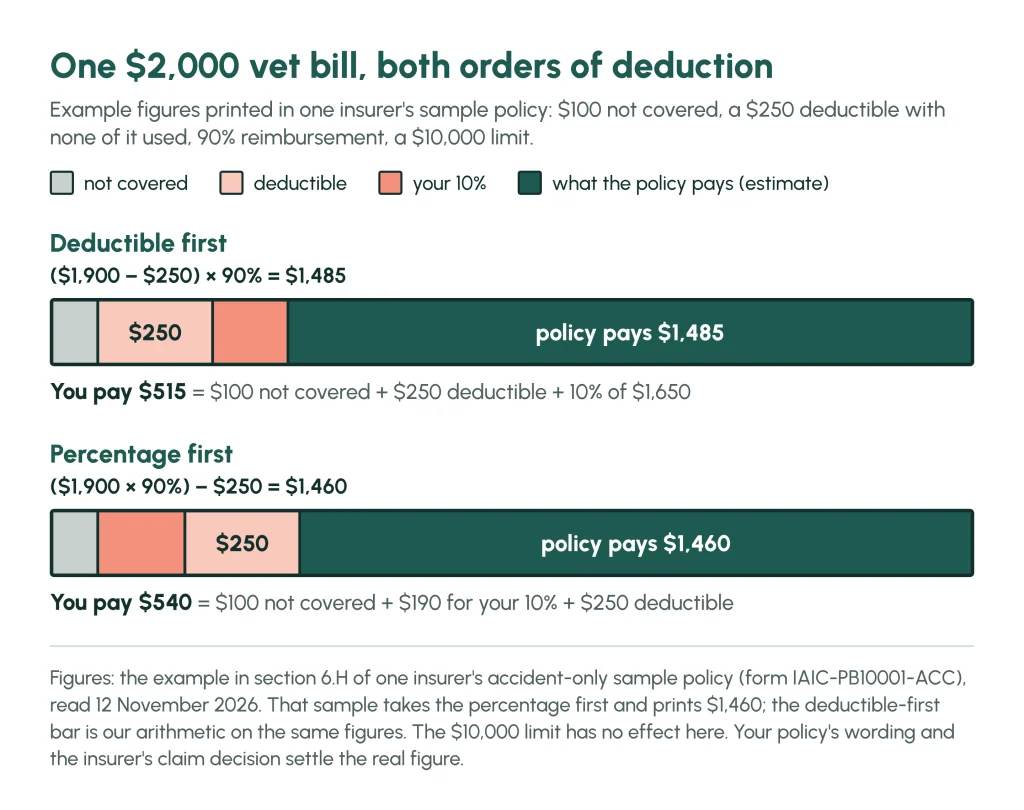
Your $540 in the percentage-first column is made of $100 not covered, $190 for your 10% and the $250 deductible. The tool lists those parts and names the largest, here the deductible, under “Which input added most to your share”.
How much the order is worth
When a claim is big enough to use up the whole deductible, percentage first pays less than deductible first by the deductible times your own percentage. In the example that is $250 × 10% = $25. The table is our arithmetic, not any insurer’s figures.
| Deductible left | 90% reimbursement | 80% reimbursement | 70% reimbursement |
|---|---|---|---|
| $100 | $10 | $20 | $30 |
| $250 | $25 | $50 | $75 |
| $500 | $50 | $100 | $150 |
| $1,000 | $100 | $200 | $300 |
The gap is paid once per deductible, so once a year with an annual deductible. It is one of several terms that differ between policies, and a policy with either order can pay more or less than another overall. This page does not say which is better. The break-even calculator runs premiums against payouts over several years in either order.
A bill smaller than the deductible
Take a $200 covered bill against a $250 deductible at 90%. Nothing is paid in either order. With deductible first, the $200 counts toward the deductible and $50 is left. For percentage first, none of the documents we read shows a worked case below the deductible, so we don’t know whether $200 or $180 (90% of it) would count. The tool therefore gives a number only for deductible first and, for percentage first, says to check your insurer’s claim statement. Whether a bill below the deductible has to be submitted before it counts is a question for your insurer.
When the limit decides
A limit is the most the policy pays. The documents we read show three kinds. The MetLife Pet sample has a limit per policy period ($5,000 in the sample) and says in its declarations that it applies to all pets insured under the policy combined. The Healthy Paws sample has a lifetime limit per pet and says there are no limits per claim or per year. The Physicians Mutual sample has an annual maximum and also a “Covered Incident Limit” per incident. The Pets Best disclosures offer annual limits of $2,500, $5,000 or $10,000, or no annual limit.
Two of the documents say plainly that the limit counts only the insurer’s payments: MetLife Pet’s limit “does not include the Deductible”, and Physicians Mutual’s annual maximum does not include the deductible, the co-pay or your coinsurance. So the calculator caps what the insurer pays at the limit left, after the rest of the sum.
An example, with our own round numbers: a $6,000 bill, all covered, a $500 deductible, 80% reimbursement and a $5,000 annual limit.
| Limit already paid out this year | Insurer pays, deductible first | Insurer pays, percentage first | You pay |
|---|---|---|---|
| $0 (all $5,000 left) | ($6,000 − $500) × 80% = $4,400 | $6,000 × 80% − $500 = $4,300 | $1,600 or $1,700 |
| $2,000 ($3,000 left) | $3,000 | $3,000 | $3,000 |
In the second row the tool reports the limit status as “this claim uses up the rest”, and with an annual limit any further bill in that policy year would be yours in full.
Per-item caps: benefit schedules and usual and customary
Some policies limit what they count for a single line of the bill, in one of two ways. A benefit schedule is a list of set amounts the policy pays per condition or procedure. A usual and customary limit lets the insurer count only what it considers the going charge for that service in your area. Either way, the part of a charge above the cap never enters the formula, so it is yours before the deductible or the percentage is applied.
We did not find a public benefit schedule to read, so we quote none. Two of the six documents have a clause of the second kind. The Physicians Mutual sample policy (form P970 (0821), “Allowable Charges Disputes”) reserves the insurer’s right to dispute charges above those “typically charged in Your geographic area” for the same treatment. The Healthy Paws sample says it does not cover amounts greater than the treating clinic’s own “standard or published charges”. Neither document gives figures.
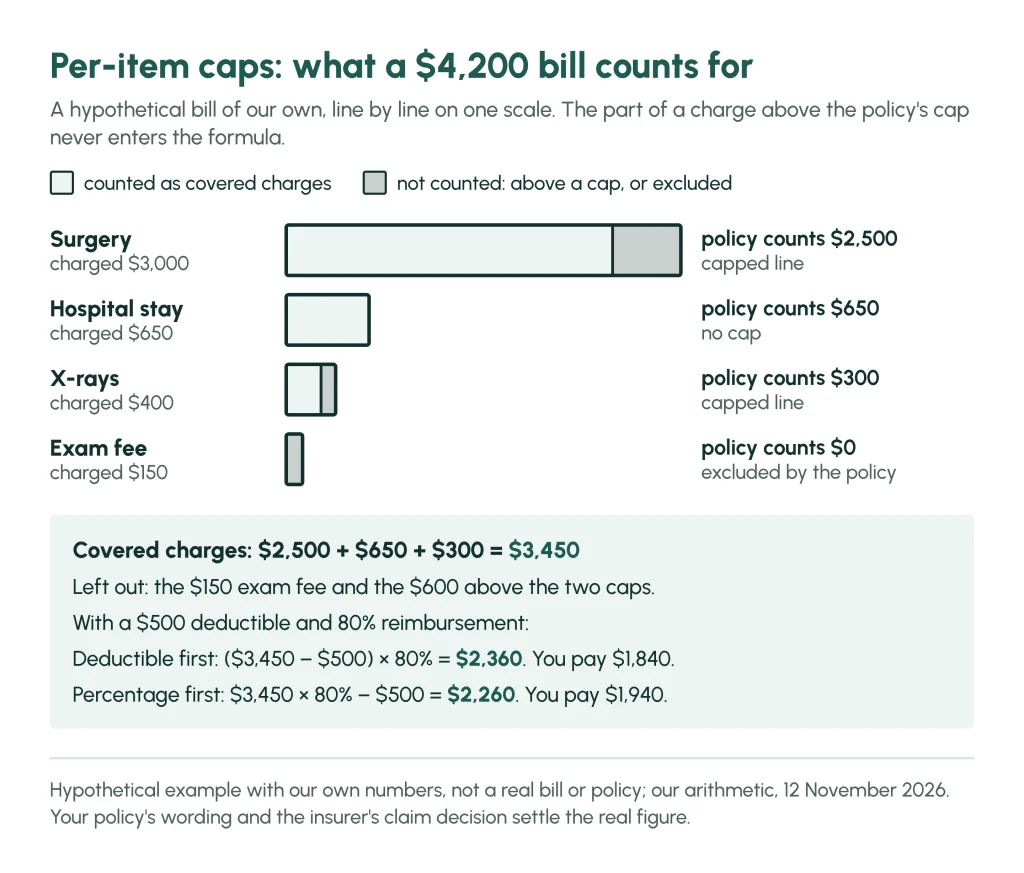
An example with our own numbers: a $4,200 bill made of surgery at $3,000 (the policy counts $2,500), a hospital stay at $650 (no cap), x-rays at $400 (the policy counts $300) and a $150 exam fee the policy excludes, with a $500 deductible and 80% reimbursement. Enter the surgery and x-ray lines as the two capped items.
- Covered charges: $2,500 + $650 + $300 = $3,450. The $150 exam fee and the $600 above the two caps are left out.
- Deductible first: ($3,450 − $500) × 80% = $2,360. You pay $1,840.
- Percentage first: $3,450 × 80% − $500 = $2,260. You pay $1,940.
- Without the caps, covered charges would be $4,200 − $150 = $4,050, and deductible first would pay ($4,050 − $500) × 80% = $2,840, so the caps cost $480 in this example.
The tool has room for two capped lines. With more, add the amount above each further cap to “Amounts your policy doesn’t cover”: the sum comes out the same.
What the law requires insurers to show you
No federal law sets how a pet insurance claim is calculated, and no state law we read sets the order of deduction, a deductible amount or a reimbursement percentage. The policy does. What some states require is that the insurer tells you its formula.
The source is the Pet Insurance Model Act (#633) of the National Association of Insurance Commissioners (NAIC), adopted in 2022. Its section 4C to 4E (read 12 November 2026; the text is copyrighted, so we paraphrase) asks insurers to disclose a summary of the basis or formula for claim payments, any benefit schedule they use, and their basis for usual and customary fees. A model act binds no one until a state passes it. Ohio’s version, which you can read on the official Ohio code site, says:
(C) A pet insurer shall clearly disclose a summary description of the basis or formula on which the pet insurer determines claim payments under the policy. This information shall also be posted through a clear and conspicuous link on the main page of the pet insurer’s or pet insurer’s program administrator’s publicly accessible web site.
(D) A pet insurer that uses a benefit schedule to determine claim payment under a pet insurance policy shall do both of the following: (1) Clearly disclose the applicable benefit schedule in the policy. (2) Disclose all benefit schedules used by the pet insurer under its pet insurance policies through a clear and conspicuous link on the main page of the pet insurer’s or pet insurer’s program administrator’s publicly accessible web site.
Ohio Revised Code 3970.04(C) and (D), effective 22 January 2025, read 12 November 2026
Division (E) of the same section requires a policy that pays by usual and customary fees to include a provision that “clearly describes the pet insurer’s basis for determining usual and customary fees and how that basis is applied in calculating claim payments”, and to post that basis through a link on the main page of its website. Division (H) requires a separate document titled “Insurer Disclosure of Important Policy Provisions” summing up these disclosures. Ohio’s chapter applies to policies issued to an Ohio resident, sold, solicited or negotiated in Ohio, or delivered or issued for delivery there (R.C. 3970.02(B), read the same day).
We read the same three duties, in nearly the same words, in two more statutes on 12 November 2026:
- Nebraska: Neb. Rev. Stat. 44-6505(3) to (5). The formula summary must be disclosed “within the policy, prior to policy issuance and through a clear and conspicuous link on the main page” of the insurer’s or its program administrator’s website. Operative 1 January 2024 (Laws 2023, LB296).
- Maine: 24-A M.R.S. 3155(3) to (5), headed “Basis for claims payments”, “Use of benefit schedule” and “Fees”. In effect since 1 January 2023 (24-A M.R.S. 3161); the Revisor’s page says its data was extracted on 5 October 2026.
California’s Insurance Code 12880.2(c) to (e) has the same three disclosures, to be made before the sale of a policy (read on the legislature’s site on 12 November 2026; as amended by Stats. 2024, ch. 612, effective 1 January 2025). Fifteen states have a law built on the model in force, and New Jersey’s starts on 1 January 2027; our table of pet insurance laws by state lists each statute with its section and read date. For this page we read the formula subsections in Ohio, Nebraska, Maine and California only. In a state with no pet insurance statute we can’t point to a law that requires the formula to be disclosed. The policy’s own wording is then the only place to find it, and you can ask the insurer to show you where.
Maine’s 24-A M.R.S. 3155(8) and Nebraska’s 44-6505(8) require a separate document with the same title as Ohio’s (both read 12 November 2026). The Pets Best Maine and Florida documents quoted above carry that heading, “Insurer Disclosure of Important Policy Provisions”, and print the formula in one sentence. If your insurer’s disclosure document or policy doesn’t make the order clear, ask the insurer in writing which comes first, the deductible or the percentage.
What the calculator leaves out
The tool does arithmetic on one bill. These things can change a real claim and are not in it:
- Whether the claim is covered at all. A waiting period that hasn’t ended, or a condition the insurer treats as pre-existing, can mean the policy pays nothing on those charges. If that applies to part of the bill, enter that part under amounts not covered.
- A per-incident co-pay. The Physicians Mutual sample has an optional “Per Incident Co-pay” taken from the allowable charges along with the deductible, and says it doesn’t count toward the deductible. If your policy has one and applies the deductible first, add the co-pay to the deductible you enter.
- Charges split between conditions. The same sample lets the insurer split one charge into a covered and a non-covered part when a visit treats both.
- Discounts and tax. The Pets Best accident-only sample says it does not reimburse discounts and that states differ on reimbursing tax. Enter what was actually charged and put tax under amounts not covered if your policy excludes it.
- Several pets on one limit, or several bills at once. Run one bill at a time, in date order, and carry the deductible left and the limit used from one run to the next.
- Filing deadlines. The MetLife Pet sample asks for the claim within 90 days of the date of service; the Pets Best accident-only sample asks for a complete claim and the paid invoice within 180 days of treatment. Your policy sets its own. Our page on filing a pet insurance claim covers the steps.
The tool also says nothing about what care a pet needs or whether to insure. Your vet decides what is right for your pet.
Your next step
- Find five things in your policy: the deductible type and how much of it is left, the reimbursement percentage, the limit and how much is used, the exclusions that touch this bill (exam fees, in some of the documents we read), and the order of deduction.
- Ask the clinic for an itemized invoice that lists each service on its own line, the subtotal, tax, the total and what you paid. The Pets Best accident-only sample asks for exactly those items, plus the pet’s name and the payment method.
- Run the calculator and keep the result beside the insurer’s claim statement when it arrives. If the two differ, look on the statement for the lines that were not covered and the amount that went to the deductible.
- If you can’t work out how a claim was calculated, ask the insurer in writing for the formula and the lines it excluded. If the answer doesn’t settle it, your state insurance department takes complaints about insurers; the NAIC keeps a directory of state insurance departments.
For a bill you haven’t received yet, the vet estimate builder shows what published sources list for each line of a procedure, so you can run a low and a high figure through this calculator.
Sources checked on 12 November 2026. The policy documents quoted are public samples and disclosure documents, each named with its form number and the date of the file we read; insurers change their forms, and the policy you hold may differ from the sample. By The Paw Bill.
Formulas and sources
- Charges above the per-item caps: Ohio R.C. 3970.04(C)-(E): insurers must disclose the claim formula, benefit schedules and usual and customary basis
- Covered charges the formula starts from: Pets Best accident-only sample policy, form IAIC-PB10001-ACC, s. 6.H: eligible charges x 90%, then less the deductible
- Reimbursement rate as a fraction: Pets Best accident-only sample policy, form IAIC-PB10001-ACC, s. 6.H: eligible charges x 90%, then less the deductible
- Limit left before this claim: MetLife Pet sample policy, form PET21-01-V (Ohio), p. 7: (treatment cost – deductible) x covered percentage; limit excludes the deductible
- Deductible first, before the limit: MetLife Pet sample policy, form PET21-01-V (Ohio), p. 7: (treatment cost – deductible) x covered percentage; limit excludes the deductible
- Percentage first, before the limit: Pets Best Florida disclosure, form APIC-PBI0012-FL (04/2025): eligible expenses x reimbursement percentage – deductible
- Insurer pays, deductible first: MetLife Pet sample policy, form PET21-01-V (Ohio), p. 7: (treatment cost – deductible) x covered percentage; limit excludes the deductible
- Insurer pays, percentage first: Pets Best accident-only sample policy, form IAIC-PB10001-ACC, s. 6.H: eligible charges x 90%, then less the deductible
- You pay, deductible first: MetLife Pet sample policy, form PET21-01-V (Ohio), p. 7: (treatment cost – deductible) x covered percentage; limit excludes the deductible
- You pay, percentage first: Pets Best accident-only sample policy, form IAIC-PB10001-ACC, s. 6.H: eligible charges x 90%, then less the deductible
- Difference between the two orders: The Paw Bill: our arithmetic on the reader's own figures; the terms come from the sample policies named on the page
- Insurer pays in the order chosen: The Paw Bill: our arithmetic on the reader's own figures; the terms come from the sample policies named on the page
- You pay in the order chosen: The Paw Bill: our arithmetic on the reader's own figures; the terms come from the sample policies named on the page
- Your share: amounts not covered: The Paw Bill: our arithmetic on the reader's own figures; the terms come from the sample policies named on the page
- Your share: above the per-item caps: The Paw Bill: our arithmetic on the reader's own figures; the terms come from the sample policies named on the page
- Your share: deductible: The Paw Bill: our arithmetic on the reader's own figures; the terms come from the sample policies named on the page
- Your share: your percentage: The Paw Bill: our arithmetic on the reader's own figures; the terms come from the sample policies named on the page
- Your share: above the limit left: Physicians Mutual sample pet policy, form P970 (0821): Allowable Charges and Annual Maximum Benefit definitions
- Largest part of your share: The Paw Bill: our arithmetic on the reader's own figures; the terms come from the sample policies named on the page
- Which input added most to your share: The Paw Bill: our arithmetic on the reader's own figures; the terms come from the sample policies named on the page
- Deductible left after this claim, deductible first: MetLife Pet sample policy, form PET21-01-V (Ohio), p. 7: (treatment cost – deductible) x covered percentage; limit excludes the deductible
- Deductible after this claim, percentage first: Pets Best accident-only sample policy, form IAIC-PB10001-ACC, s. 6.H: eligible charges x 90%, then less the deductible
- What the deductible left applies to: The Paw Bill: our arithmetic on the reader's own figures; the terms come from the sample policies named on the page
- Limit left after this claim: MetLife Pet sample policy, form PET21-01-V (Ohio), p. 7: (treatment cost – deductible) x covered percentage; limit excludes the deductible
- Limit status: MetLife Pet sample policy, form PET21-01-V (Ohio), p. 7: (treatment cost – deductible) x covered percentage; limit excludes the deductible
Sources
- MetLife Pet sample accident and illness policy, form PET21-01-V (Ohio sample; Metropolitan General Insurance Company; PDF dated Feb 2024; read 12 Nov 2026): deductible once per policy period, worked example p. 7, policy limit definition, 90-day claim deadline
- Healthy Paws sample Pet Health Insurance Policy, form LD-50812 (07/18) (Westchester Fire Insurance Company; PDF dated Dec 2025; read 12 Nov 2026 from a US server): coinsurance and deductible definitions, lifetime limit, exam fee exclusion
- Pets Best policy booklet with Maine Insurer Disclosure of Important Policy Provisions, form APIC-PBI0012-ME (11/2022) (American Pet Insurance Company; PDF dated Sep 2026; read 12 Nov 2026)
- Pets Best policy booklet with Florida Insurer Disclosure of Important Policy Provisions, form APIC-PBI0012-FL (04/2025) (American Pet Insurance Company; PDF dated Sep 2026; read 12 Nov 2026): the reimbursement formula
- Pets Best accident-only sample policy, form IAIC-PB10001-ACC (Independence American Insurance Company; PDF dated Sep 2026; read 12 Nov 2026): s. 6.H example of reimbursement calculation
- Physicians Mutual sample Pet Insurance Policy, form P970 (0821) (PDF dated Jun 2022; read 12 Nov 2026): deductible then coinsurance, Annual Maximum Benefit, Covered Incident Limit, Allowable Charges Disputes
- Trupanion, Deductible Frequently Asked Questions (flyer, PDF dated Feb 2012; read 12 Nov 2026): a per-condition deductible, cited as a dated example only
- Ohio Revised Code 3970.04 (effective 22 Jan 2025; read 12 Nov 2026) and 3970.02(B)
- Nebraska Revised Statutes 44-6505(3)-(5) and (8) (Laws 2023, LB296; read 12 Nov 2026)
- Maine Revised Statutes Title 24-A, section 3155(3)-(5) and (8) (PL 2021, c. 562; page data extracted 5 Oct 2026; read 12 Nov 2026); effective date in section 3161
- California Insurance Code 12880.2(c)-(e) (amended by Stats. 2024, ch. 612, effective 1 Jan 2025; read 12 Nov 2026)
- NAIC Pet Insurance Model Act (#633), 2022, section 4C-4E (copyrighted; paraphrased; read 12 Nov 2026)
- NAIC, state insurance departments directory